
Note
Go to the end to download the full example code.
Quantizes and dequantizes selected pages of a KV cache#
This example executes ai.rt::QuantizePagedCache twice in one graph:
first to quantize one page, then to restore its dense floating-point storage.
Other pages remain unchanged. The cache is a PagedCacheProto, not one
uniformly quantized tensor: K and V can use different formats on each page.
The example uses supported affine INT4/UINT4 storage, not the generic
Q4_K/Q5_K profiles. See Persistent input/output feedback for the
paged-cache and persistence contracts.
import matplotlib.pyplot
import numpy

from onnx_light import onnx
import onnx_light.onnx.numpy_helper as onh
import onnx_light.onnx.helper as oh
from onnx_light.onnx_proto import verify
from onnx_light.onnx_py._onnxpykernels.runtime import (
    RuntimeContext,
    RuntimeSession,
    tensor_from_proto,
)
Create a cache with two pages#
Each payload has shape [batch=1, heads=1, capacity=2, width=4]. The first page contains two tokens. The second contains only one: its unused row contains NaNs to demonstrate that conversion reads only the valid prefix, preserves capacity, and initializes unused output rows.
cache = onnx.PagedCacheProto()
first = cache.blocks.add()
first.start = 0
first.length = 2
first_keys = numpy.linspace(-0.5, 0.5, 8, dtype=numpy.float32).reshape(1, 1, 2, 4)
first.key.CopyFrom(onh.from_array(first_keys))
first.value.CopyFrom(onh.from_array(-first_keys))

second = cache.blocks.add()
second.start = 2
second.length = 1
keys = numpy.array(
    [-1.3, -0.4, 0.3, 1.2, numpy.nan, numpy.nan, numpy.nan, numpy.nan], dtype=numpy.float32
).reshape(1, 1, 2, 4)
values = numpy.array(
    [-0.8, -0.3, 0.2, 0.7, numpy.nan, numpy.nan, numpy.nan, numpy.nan], dtype=numpy.float32
).reshape(1, 1, 2, 4)
second.key.CopyFrom(onh.from_array(keys))
second.value.CopyFrom(onh.from_array(values))
Build the quantization/dequantization graph#
The dtype of each zero-point input selects the destination format: INT4 for K, UINT4 for V, then FLOAT16 and BFLOAT16 for dense restoration. Integer zero-point values participate in the affine transform. Floating zero-points are only type markers; their values and scales are ignored numerically, although scales must still be positive finite FLOAT scalars.
An empty struct declaration lets the runtime validate the cache layout. These nodes are onnx-light extensions, not standard ONNX operators.
cache_type = onnx.TypeProto(struct_type=onnx.StructTypeProto())
model = oh.make_model(
    oh.make_graph(
        [
            oh.make_node(
                "QuantizePagedCache",
                ["past", "indices", "key_scale", "key_zero", "value_scale", "value_zero"],
                ["quantized"],
                domain="ai.rt",
            ),
            oh.make_node(
                "QuantizePagedCache",
                ["quantized", "indices", "one", "float16_marker", "one", "bfloat16_marker"],
                ["restored"],
                domain="ai.rt",
            ),
        ],
        "selected_page_roundtrip",
        [
            oh.make_value_info("past", cache_type),
            oh.make_tensor_value_info("indices", onnx.TensorProto.INT64, [1]),
        ],
        [oh.make_value_info("quantized", cache_type), oh.make_value_info("restored", cache_type)],
        initializer=[
            oh.make_tensor("key_scale", onnx.TensorProto.FLOAT, [], [0.25]),
            oh.make_tensor("key_zero", onnx.TensorProto.INT4, [], [0]),
            oh.make_tensor("value_scale", onnx.TensorProto.FLOAT, [], [0.125]),
            oh.make_tensor("value_zero", onnx.TensorProto.UINT4, [], [8]),
            oh.make_tensor("one", onnx.TensorProto.FLOAT, [], [1]),
            oh.make_tensor("float16_marker", onnx.TensorProto.FLOAT16, [], [0]),
            oh.make_tensor("bfloat16_marker", onnx.TensorProto.BFLOAT16, [], [0]),
        ],
    ),
    opset_imports=[oh.make_opsetid("", 23), oh.make_opsetid("ai.rt", 1)],
    ir_version=10,
)
verify.verify_model(model)
Run with page index 1#
Importing the native runtime registers QuantizePagedCache. Structured values use put_value/get_value; tensor inputs use set/get. Both cache outputs are declared so they remain available for inspection.
context = RuntimeContext()
context.put_value("past", cache)
context.set("indices", tensor_from_proto(onh.from_array(numpy.array([1], numpy.int64))))
session = RuntimeSession(model)
session.run(context)
quantized = context.get_value("quantized")
restored = context.get_value("restored")
assert isinstance(quantized, onnx.PagedCacheProto)
assert isinstance(restored, onnx.PagedCacheProto)

for output in (quantized, restored):
    assert len(output.blocks) == 2
    numpy.testing.assert_array_equal(onh.to_array(output.blocks[0].key), first_keys)
    numpy.testing.assert_array_equal(onh.to_array(output.blocks[0].value), -first_keys)
    assert output.blocks[1].start == 2
    assert output.blocks[1].length == 1

encoded_page = quantized.blocks[1]
assert encoded_page.encoded_key.affine.storage_type == onnx.TensorProto.INT4
assert encoded_page.encoded_value.affine.storage_type == onnx.TensorProto.UINT4
assert len(encoded_page.encoded_key.raw_data) == 4
assert len(encoded_page.encoded_value.raw_data) == 4
print("Page 0: unchanged FLOAT K/V.")
print("Page 1: INT4 K / UINT4 V, 8 payload bytes instead of 64 (excluding metadata).")
Page 0: unchanged FLOAT K/V.
Page 1: INT4 K / UINT4 V, 8 payload bytes instead of 64 (excluding metadata).
Check reconstruction and partial-page capacity#
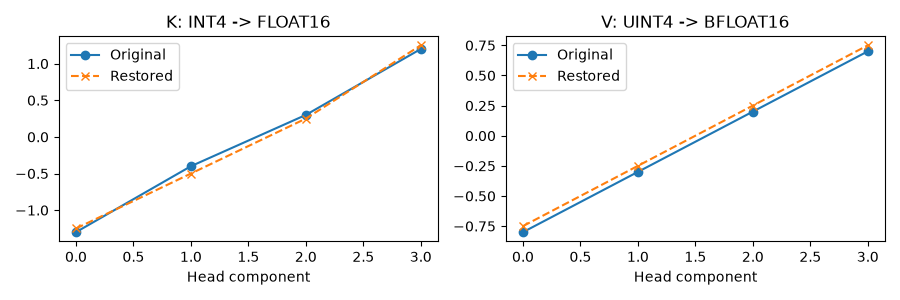
Dequantization restores the quantized approximation, not the original values. The chosen inputs do not saturate; the maximum error is half the corresponding scale. Only the selected page becomes FLOAT16/BFLOAT16.
restored_keys = onh.to_array(restored.blocks[1].key)
restored_values = onh.to_array(restored.blocks[1].value)
assert restored_keys.shape == restored_values.shape == (1, 1, 2, 4)
assert restored.blocks[1].key.data_type == onnx.TensorProto.FLOAT16
assert restored.blocks[1].value.data_type == onnx.TensorProto.BFLOAT16
expected_keys = numpy.clip(numpy.rint(keys[:, :, :1] / 0.25), -8, 7) * 0.25
expected_values = (numpy.clip(numpy.rint(values[:, :, :1] / 0.125) + 8, 0, 15) - 8) * 0.125
numpy.testing.assert_array_equal(restored_keys[:, :, :1], expected_keys)
numpy.testing.assert_array_equal(restored_values[:, :, :1].astype(numpy.float32), expected_values)
numpy.testing.assert_array_equal(restored_keys[:, :, 1:], 0)
numpy.testing.assert_array_equal(restored_values[:, :, 1:].astype(numpy.float32), 0)
assert numpy.max(numpy.abs(restored_keys[:, :, :1] - keys[:, :, :1])) <= 0.125
assert (
    numpy.max(numpy.abs(restored_values[:, :, :1].astype(numpy.float32) - values[:, :, :1]))
    <= 0.0625
)
print("Restored page: FLOAT16 K / BFLOAT16 V, capacity 2, valid length 1.")
print("K:", restored_keys[:, :, :1].ravel())
print("V:", restored_values[:, :, :1].astype(numpy.float32).ravel())
Restored page: FLOAT16 K / BFLOAT16 V, capacity 2, valid length 1.
K: [-1.25 -0.5   0.25  1.25]
V: [-0.75 -0.25  0.25  0.75]
Serialize and reuse the mixed-format cache#
PagedCacheProto preserves the independent payload formats. The restored message can be fed into another session; here the same graph requantizes and dequantizes it again with identical parameters.
reloaded = onnx.PagedCacheProto()
reloaded.ParseFromString(quantized.SerializeToString())
context.put_value("past", reloaded)
session.run(context)
again = context.get_value("restored")
numpy.testing.assert_array_equal(onh.to_array(again.blocks[1].key), restored_keys)
numpy.testing.assert_array_equal(
    onh.to_array(again.blocks[1].value).astype(numpy.float32),
    restored_values.astype(numpy.float32),
)
Compare the valid token before and after conversion#
figure, axes = matplotlib.pyplot.subplots(1, 2, figsize=(9, 3))
for axis, name, source, result in (
    (axes[0], "K: INT4 -> FLOAT16", keys, restored_keys),
    (axes[1], "V: UINT4 -> BFLOAT16", values, restored_values),
):
    axis.plot(source[:, :, :1].ravel(), "o-", label="Original")
    axis.plot(result[:, :, :1].astype(numpy.float32).ravel(), "x--", label="Restored")
    axis.set_title(name)
    axis.set_xlabel("Head component")
    axis.legend()
figure.tight_layout()
Total running time of the script: (0 minutes 0.205 seconds)
Related examples

Uses every portable quantization profile from Python
Run the reference evaluator with tensor, sequence and dictionary inputs/outputs
Gallery generated by Sphinx-Gallery
Example last updated
- Date:
2026-10-05