
Note
Go to the end to download the full example code.
Calibrates quantization with graph kernels#
This example runs ai.rt::Quantize and ai.rt::Dequantize in a native
runtime session. It first demonstrates linear INT8 quantization with a scale
and zero point, then compares automatic NF4 block calibration with explicit
scales, inspects the encoded graph output, and reuses it as an initializer.
These operators are onnx-light extensions, not ONNX QuantizeLinear and
DequantizeLinear. See Quantizes tensors into encoded values for supported formats and
the additional parameters required by learned or transformed layouts.
import matplotlib.pyplot
import numpy

from onnx_light import onnx
import onnx_light.onnx.helper as oh
import onnx_light.onnx.numpy_helper as onh
from onnx_light.onnx_core.quantization import (
    QuantizationFormat,
    make_quantization_plan,
    make_quantization_type,
)
from onnx_light.onnx_py._onnxpykernels.runtime import (
    RuntimeContext,
    RuntimeSession,
    tensor_from_proto,
)
Linear quantization and dequantization with INT8#
This graph uses Quantize and Dequantize, not QuantizeLinear and DequantizeLinear, to implement the familiar affine equations:
q = clip(round(X / scale) + zero_point, -128, 127)Y = (q - zero_point) * scale
One block covers the whole tensor, so a scalar scale and zero point apply
to every element. They are supplied as floating tensor initializers; the
zero point must still have an integer value. Unlike QuantizeLinear, the
intermediate Q is an EncodedValueProto containing both the INT8 codes
and their reconstruction parameters, not a bare INT8 tensor.
Dequantize only needs that encoded value and its requested output dtype. The endpoints below deliberately demonstrate saturation to the code range.
linear_values = numpy.array([-40, -1, -0.6, 0, 0.6, 1, 40], dtype=numpy.float32)
linear_scale = numpy.array(0.25, dtype=numpy.float32)
linear_zero_point = numpy.array(-3, dtype=numpy.float32)
linear_plan = make_quantization_plan(
    QuantizationFormat.INT8, linear_values.size, block_size=linear_values.size
)
linear_type = onnx.TypeProto()
linear_type.struct_type.CopyFrom(make_quantization_type(linear_plan))
linear_graph = oh.make_graph(
    [
        oh.make_node(
            "Quantize", ["X", "scale", "zero_point"], ["Q"], domain="ai.rt", type=linear_type
        ),
        oh.make_node("Dequantize", ["Q"], ["Y"], domain="ai.rt", dtype=onnx.TensorProto.FLOAT),
    ],
    "linear_quantization",
    [oh.make_tensor_value_info("X", onnx.TensorProto.FLOAT, [linear_values.size])],
    [oh.make_tensor_value_info("Y", onnx.TensorProto.FLOAT, [linear_values.size])],
    initializer=[
        onh.from_array(linear_scale, name="scale"),
        onh.from_array(linear_zero_point, name="zero_point"),
    ],
)
linear_model = oh.make_model(
    linear_graph, opset_imports=[oh.make_opsetid("", 21), oh.make_opsetid("ai.rt", 1)]
)
linear_context = RuntimeContext()
linear_context.set("X", tensor_from_proto(onh.from_array(linear_values, name="X")))
linear_session = RuntimeSession(linear_model)
linear_session.run(linear_context)
linear_output = numpy.from_dlpack(linear_context.get("Y"))
reference_codes = numpy.clip(
    numpy.rint(linear_values / linear_scale) + linear_zero_point, -128, 127
).astype(numpy.int8)
reference_output = (reference_codes.astype(numpy.float32) - linear_zero_point) * linear_scale
numpy.testing.assert_array_equal(reference_codes, [-128, -7, -5, -3, -1, 1, 127])
numpy.testing.assert_array_equal(linear_output, reference_output)
numpy.testing.assert_array_equal(linear_output, [-31.25, -1, -0.5, 0, 0.5, 1, 32.5])
assert linear_output.dtype == numpy.float32
print("Linear input:          ", linear_values)
print("Reference INT8 codes:  ", reference_codes)
print("Quantize -> Dequantize:", linear_output)
Linear input:           [-40.   -1.   -0.6   0.    0.6   1.   40. ]
Reference INT8 codes:   [-128   -7   -5   -3   -1    1  127]
Quantize -> Dequantize: [-31.25  -1.    -0.5    0.     0.5    1.    32.5 ]
Nonlinear quantization with an NF4 codebook#
NF4 stores four-bit indices into a fixed table of 16 nonuniform values,
rather than uniformly spaced integer codes. Quantize selects the nearest
table entry after scaling; Dequantize reconstructs scale * codebook[index].
There is no affine zero-point shift.
Each block covers four consecutive elements and has its own scale. The type describes the storage layout, not the numerical scales: Quantize computes those from each input block. The encoded value keeps the logical FLOAT input dtype; Dequantize requests a DOUBLE output independently.
Declaring Q as a graph output retains it for inspection after the run.
Encoded outputs use get_value rather than the tensor-only get.
Importing the native runtime above registers its built-in kernels.
values = numpy.array([-8, -3.3, 0.2, 7, -16, -1.2, 8.5, 14], dtype=numpy.float32)
plan = make_quantization_plan(QuantizationFormat.NF4, values.size, block_size=4)
codebook = numpy.array(plan.run(0).block(0).codebook, dtype=numpy.float64)
assert codebook.size == 16
assert not numpy.allclose(numpy.diff(codebook), numpy.diff(codebook)[0])
print("Nonuniform NF4 codebook:", codebook)
destination = onnx.TypeProto()
destination.struct_type.CopyFrom(make_quantization_type(plan))
encode = oh.make_node("Quantize", ["X"], ["Q"], domain="ai.rt", type=destination)
decode = oh.make_node("Dequantize", ["Q"], ["Y"], domain="ai.rt", dtype=onnx.TensorProto.DOUBLE)
graph = oh.make_graph(
    [encode, decode],
    "automatic_quantization",
    [oh.make_tensor_value_info("X", onnx.TensorProto.FLOAT, [values.size])],
    [
        oh.make_value_info("Q", destination),
        oh.make_tensor_value_info("Y", onnx.TensorProto.DOUBLE, [values.size]),
    ],
)
model = oh.make_model(graph, opset_imports=[oh.make_opsetid("", 21), oh.make_opsetid("ai.rt", 1)])
Nonuniform NF4 codebook: [-1.         -0.6961928  -0.52507305 -0.39491749 -0.28444138 -0.18477343
 -0.09105004  0.          0.0795803   0.1609302   0.2461123   0.33791524
  0.44070983  0.562617    0.72295684  1.        ]
Calibrate scales from the input#
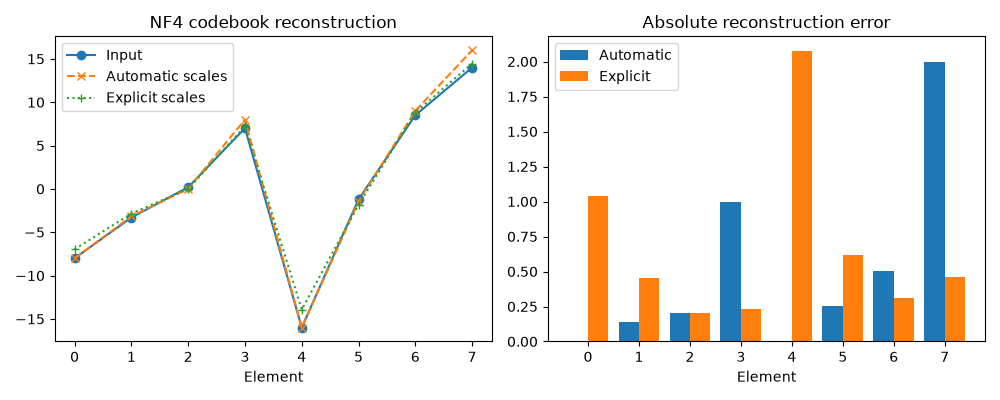
The NF4 table spans [-1, 1], so calibration uses each block’s maximum absolute value: 8 and 16 here. Unlike linear quantization, reconstruction selects among nonuniform levels. The NumPy reference below searches those levels independently of the native kernels.
def reconstruct_nf4(source, block_scales):
    """Returns the nearest scaled NF4 table entry for each source element."""
    blocks = source.astype(numpy.float64).reshape(-1, 4)
    levels = block_scales[:, None] * codebook[None, :]
    distances = numpy.abs(blocks[:, :, None] - levels[:, None, :])
    indices = distances.argmin(axis=2)
    return numpy.take_along_axis(levels, indices, axis=1).reshape(source.shape)


context = RuntimeContext()
context.set("X", tensor_from_proto(onh.from_array(values, name="X")))
session = RuntimeSession(model)
session.run(context)
automatic = numpy.from_dlpack(context.get("Y"))
encoded = context.get_value("Q")
assert isinstance(encoded, onnx.EncodedValueProto)
assert automatic.dtype == numpy.float64
automatic_scales = numpy.max(numpy.abs(values.reshape(-1, 4)), axis=1).astype(numpy.float64)
numpy.testing.assert_array_equal(automatic_scales, [8, 16])
numpy.testing.assert_allclose(
    automatic, reconstruct_nf4(values, automatic_scales), rtol=1e-12, atol=1e-12
)
print("Input:     ", values)
print("Automatic: ", automatic)
print("Encoded output:", type(encoded).__name__)
Input:      [ -8.   -3.3   0.2   7.  -16.   -1.2   8.5  14. ]
Automatic:  [ -8.          -3.1593399    0.           8.         -16.
  -1.45680058   9.00187206  16.        ]
Encoded output: EncodedValueProto
Override the scales explicitly#
The optional second input supplies one scale per block (or a scalar for all blocks). Scales 10 and 20 widen the reconstruction ranges and move the nonuniform levels. They need not improve accuracy. The parameter dtype can differ from the input dtype. NF4 zero points and offsets remain zero. Other profiles may require learned tables or transforms; choosing a profile does not train those parameters.
explicit_model = onnx.ModelProto()
explicit_model.CopyFrom(model)
explicit_model.graph.node[0].input.append("scales")
explicit_model.graph.input.append(
    oh.make_tensor_value_info("scales", onnx.TensorProto.DOUBLE, [2])
)
scales = numpy.array([10, 20], dtype=numpy.float64)
explicit_context = RuntimeContext()
explicit_context.set("X", context.get("X"))
explicit_context.set("scales", tensor_from_proto(onh.from_array(scales, name="scales")))
explicit_session = RuntimeSession(explicit_model)
explicit_session.run(explicit_context)
explicit = numpy.from_dlpack(explicit_context.get("Y"))
numpy.testing.assert_allclose(explicit, reconstruct_nf4(values, scales), rtol=1e-12, atol=1e-12)
print("Explicit:  ", explicit)
Explicit:   [ -6.96192801  -2.84441382   0.           7.22956836 -13.92385602
  -1.82100073   8.81419659  14.45913672]
Serialize and reuse the encoded value#
The encoded message contains its inline storage type and calibrated
parameters. A Dequantize-only graph can therefore reconstruct it without
the original input or plan. It belongs in encoded_initializer, not in
the ordinary tensor initializer collection.
restored = onnx.EncodedValueProto()
restored.ParseFromString(encoded.SerializeToString())
initializer_graph = oh.make_graph(
    [decode],
    "decode_encoded_initializer",
    [],
    [oh.make_tensor_value_info("Y", onnx.TensorProto.DOUBLE, [values.size])],
)
initializer_graph.encoded_initializer.append(restored)
initializer_model = oh.make_model(initializer_graph, opset_imports=[oh.make_opsetid("ai.rt", 1)])
initializer_context = RuntimeContext()
initializer_session = RuntimeSession(initializer_model)
initializer_session.run(initializer_context)
reconstructed = numpy.from_dlpack(initializer_context.get("Y"))
numpy.testing.assert_array_equal(reconstructed, automatic)
print("Serialized:", reconstructed)
Serialized: [ -8.          -3.1593399    0.           8.         -16.
  -1.45680058   9.00187206  16.        ]
Compare reconstruction errors#
The two scale choices yield different NF4 reconstruction levels. Neither simple range calibration nor this small example guarantees optimal accuracy for a real model.
figure, axes = matplotlib.pyplot.subplots(1, 2, figsize=(10, 4))
axes[0].plot(values, "o-", label="Input")
axes[0].plot(automatic, "x--", label="Automatic scales")
axes[0].plot(explicit, "+:", label="Explicit scales")
axes[0].set_title("NF4 codebook reconstruction")
axes[0].set_xlabel("Element")
axes[0].legend()
indices = numpy.arange(values.size)
axes[1].bar(indices - 0.2, numpy.abs(automatic - values), width=0.4, label="Automatic")
axes[1].bar(indices + 0.2, numpy.abs(explicit - values), width=0.4, label="Explicit")
axes[1].set_title("Absolute reconstruction error")
axes[1].set_xlabel("Element")
axes[1].legend()
figure.tight_layout()
Total running time of the script: (0 minutes 0.249 seconds)
Related examples

Uses every portable quantization profile from Python
Quantizes and dequantizes selected pages of a KV cache
Benchmark a subset of backend test cases against onnxruntime
Gallery generated by Sphinx-Gallery
Example last updated
- Date:
2026-10-05