
Note
Go to the end to download the full example code.
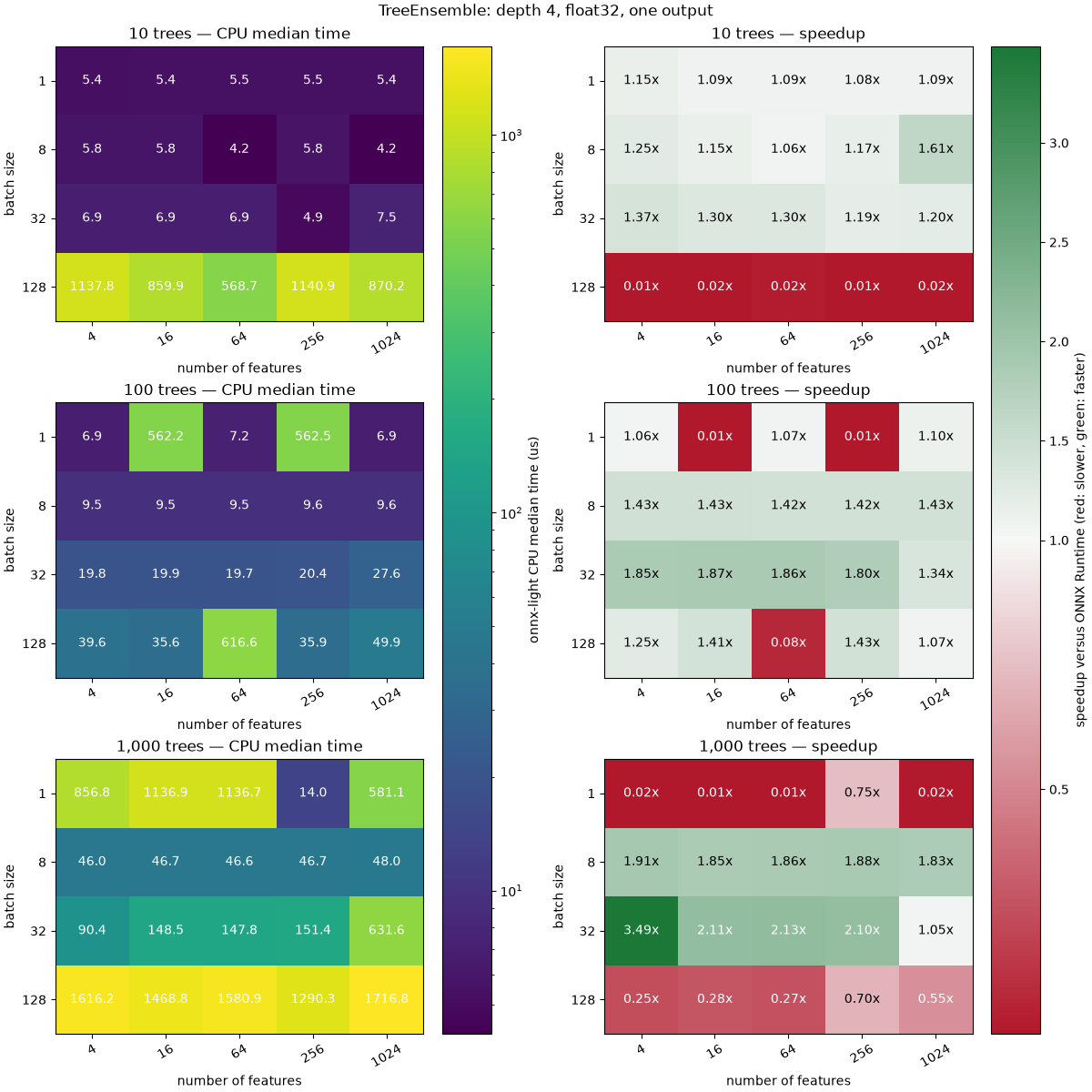
Benchmark TreeEnsemble scheduling scenarios#
This example measures TreeEnsemble-5 regression forests while varying the
number of trees, input features, and batch size. Batch size 1 is represented
explicitly because ONNX Runtime uses a specialized execution path for that
case. The largest forest contains 10,000 trees and the widest input contains
4,096 features, both representative of production models. Those largest
configurations are enabled by --big, which defaults to True on machines
with more than 64 cores and can be disabled with --no-big.
The example is standalone: it builds every model, runs ONNX Runtime and onnx-light + onnx-light-cpu, and measures both without relying on any script from the repository.
import argparse
import gc
import os
import statistics
import time

import matplotlib.pyplot as plt
from matplotlib.colors import LinearSegmentedColormap, LogNorm, TwoSlopeNorm
import numpy as np
import onnxruntime

# ``onnx-light`` ships ``onnx_light.onnx`` as a drop-in replacement for the
# ``onnx`` package; use it to build the models so the example depends on
# onnx-light rather than onnx.
from onnx_light.onnx import TensorProto, checker, helper, numpy_helper
from onnx_light.onnx.reference import ReferenceEvaluator

from onnx_light_cpu import register_kernels

cpu_count = os.cpu_count() or 1

parser = argparse.ArgumentParser(description=__doc__)
parser.add_argument("-r", "--repeat", type=int, default=10 * cpu_count)
parser.add_argument("-w", "--warmup", type=int, default=2 * cpu_count)
parser.add_argument("-t", "--max-repeat-time", type=float, default=1.0)
parser.add_argument(
    "--big",
    action=argparse.BooleanOptionalAction,
    default=cpu_count > 64,
    help=(
        "include configurations with 10,000 trees or 4,096 features, "
        "enabled by default on machines with more than 64 cores"
    ),
)
args, _ = parser.parse_known_args()
if args.repeat <= 0:
    parser.error("--repeat must be greater than 0")
if args.warmup < 0:
    parser.error("--warmup must be greater than or equal to 0")
if args.max_repeat_time <= 0:
    parser.error("--max-repeat-time must be greater than 0")

if os.environ.get("UNITTEST_GOING"):
    tree_counts = (10, 100)
    feature_counts = (4, 64)
    batch_sizes = (1, 32)
else:
    tree_counts = (10, 100, 1000, 10000) if args.big else (10, 100, 1000)
    feature_counts = (4, 16, 64, 256, 1024, 4096) if args.big else (4, 16, 64, 256, 1024)
    batch_sizes = (1, 8, 32, 128)
Build one model per configuration#
Every configuration is a TreeEnsemble regression forest of depth 4 with a
single output, built directly here so the example runs on its own.
DEPTH = 4


def make_case(trees, features, rows, seed):
    internal_count = (1 << DEPTH) - 1
    leaf_count = 1 << DEPTH
    nodes_featureids = []
    nodes_splits = []
    true_ids = []
    false_ids = []
    true_leafs = []
    false_leafs = []
    leaf_weights = []
    for tree in range(trees):
        node_offset = tree * internal_count
        leaf_offset = tree * leaf_count
        for local_node in range(internal_count):
            nodes_featureids.append((tree + local_node) % features)
            nodes_splits.append(((local_node % 7) - 3) * 0.25)
            for child, ids, leafs in (
                (2 * local_node + 1, true_ids, true_leafs),
                (2 * local_node + 2, false_ids, false_leafs),
            ):
                if child >= internal_count:
                    ids.append(leaf_offset + child - internal_count)
                    leafs.append(1)
                else:
                    ids.append(node_offset + child)
                    leafs.append(0)
        for leaf in range(leaf_count):
            leaf_weights.append(((leaf + tree) % 11 - 5) / (max(trees, 1) * 8.0))

    node = helper.make_node(
        "TreeEnsemble",
        ["X"],
        ["scores"],
        domain="ai.onnx.ml",
        tree_roots=[tree * internal_count for tree in range(trees)],
        nodes_featureids=nodes_featureids,
        nodes_splits=numpy_helper.from_array(np.asarray(nodes_splits, dtype=np.float32)),
        nodes_modes=numpy_helper.from_array(np.zeros(len(nodes_splits), dtype=np.uint8)),
        nodes_truenodeids=true_ids,
        nodes_falsenodeids=false_ids,
        nodes_trueleafs=true_leafs,
        nodes_falseleafs=false_leafs,
        leaf_targetids=[0] * len(leaf_weights),
        leaf_weights=numpy_helper.from_array(np.asarray(leaf_weights, dtype=np.float32)),
        n_targets=1,
        aggregate_function=1,
        post_transform=0,
    )
    graph = helper.make_graph(
        [node],
        f"tree_grid_t{trees}_f{features}_b{rows}",
        [helper.make_tensor_value_info("X", TensorProto.FLOAT, [rows, features])],
        [helper.make_tensor_value_info("scores", TensorProto.FLOAT, [rows, 1])],
    )
    model = helper.make_model(
        graph,
        opset_imports=[helper.make_opsetid("", 18), helper.make_opsetid("ai.onnx.ml", 5)],
        ir_version=13,
    )
    checker.check_model(model)
    rng = np.random.default_rng(seed)
    feeds = {"X": rng.standard_normal((rows, features)).astype(np.float32)}
    return model.SerializeToString(), feeds
Measure both runtimes#
measure returns the median duration of a callable, stopping early once
--max-repeat-time seconds have been spent.
def measure(function, repeat, warmup, max_duration):
    spent = 0.0
    for _ in range(warmup):
        start = time.perf_counter_ns()
        function()
        spent += (time.perf_counter_ns() - start) / 1e9
        if spent >= max_duration:
            break
    timings = []
    spent = 0.0
    gc_enabled = gc.isenabled()
    gc.disable()
    try:
        for _ in range(repeat):
            start = time.perf_counter_ns()
            function()
            duration = (time.perf_counter_ns() - start) / 1e9
            timings.append(duration)
            spent += duration
            if spent >= max_duration:
                break
    finally:
        if gc_enabled:
            gc.enable()
    return statistics.median(timings)


register_kernels()
threads = min(4, cpu_count)
options = onnxruntime.SessionOptions()
options.intra_op_num_threads = threads
options.inter_op_num_threads = 1
options.execution_mode = onnxruntime.ExecutionMode.ORT_SEQUENTIAL

records = []
for seed, (trees, features, batch) in enumerate(
    (trees, features, batch)
    for trees in tree_counts
    for features in feature_counts
    for batch in batch_sizes
):
    model, feeds = make_case(trees, features, batch, seed)
    cpu_session = ReferenceEvaluator(
        model, cpu_execution={"num_threads": threads, "affinity_policy": "none"}
    )
    ort_session = onnxruntime.InferenceSession(
        model, sess_options=options, providers=["CPUExecutionProvider"]
    )

    def cpu_run(session=cpu_session, current_feeds=feeds):
        return session.run(None, current_feeds)

    def ort_run(session=ort_session, current_feeds=feeds):
        return session.run(None, current_feeds)

    np.testing.assert_allclose(cpu_run()[0], ort_run()[0], rtol=2e-5, atol=2e-5)
    cpu_median = measure(cpu_run, args.repeat, args.warmup, args.max_repeat_time)
    ort_median = measure(ort_run, args.repeat, args.warmup, args.max_repeat_time)
    records.append(
        {
            "trees": trees,
            "features": features,
            "rows": batch,
            "cpu_median_seconds": cpu_median,
            "ort_median_seconds": ort_median,
            "speedup": ort_median / cpu_median,
        }
    )
    print(
        f"trees={trees:6d} features={features:5d} batch={batch:4d} "
        f"onnx-light-cpu={cpu_median * 1e6:10.2f}us "
        f"onnxruntime={ort_median * 1e6:10.2f}us "
        f"speedup={ort_median / cpu_median:.2f}x"
    )
trees=    10 features=    4 batch=   1 onnx-light-cpu=      2.61us onnxruntime=      5.08us speedup=1.94x
trees=    10 features=    4 batch=  32 onnx-light-cpu=      3.63us onnxruntime=      7.30us speedup=2.01x
trees=    10 features=   64 batch=   1 onnx-light-cpu=      2.62us onnxruntime=      4.97us speedup=1.89x
trees=    10 features=   64 batch=  32 onnx-light-cpu=      3.64us onnxruntime=      7.24us speedup=1.99x
trees=   100 features=    4 batch=   1 onnx-light-cpu=      3.30us onnxruntime=      6.04us speedup=1.83x
trees=   100 features=    4 batch=  32 onnx-light-cpu=     12.03us onnxruntime=     26.88us speedup=2.23x
trees=   100 features=   64 batch=   1 onnx-light-cpu=      3.32us onnxruntime=      6.00us speedup=1.80x
trees=   100 features=   64 batch=  32 onnx-light-cpu=     11.79us onnxruntime=     26.27us speedup=2.23x
Plot the timings and the speedups#
by_dimensions = {(row["trees"], row["rows"], row["features"]): row for row in records}
timings = {
    trees: np.array(
        [
            [
                by_dimensions[(trees, batch, features)]["cpu_median_seconds"] * 1e6
                for features in feature_counts
            ]
            for batch in batch_sizes
        ]
    )
    for trees in tree_counts
}
speedups = {
    trees: np.array(
        [
            [by_dimensions[(trees, batch, features)]["speedup"] for features in feature_counts]
            for batch in batch_sizes
        ]
    )
    for trees in tree_counts
}
all_timings = np.concatenate([values.ravel() for values in timings.values()])
all_speedups = np.concatenate([values.ravel() for values in speedups.values()])
timing_norm = LogNorm(vmin=float(all_timings.min()), vmax=float(all_timings.max()))
speedup_norm = TwoSlopeNorm(
    vmin=min(0.5, float(all_speedups.min())),
    vcenter=1.0,
    vmax=max(1.5, float(all_speedups.max())),
)
speedup_cmap = LinearSegmentedColormap.from_list(
    "slower_neutral_faster", ["#b2182b", "#f7f7f7", "#1b7837"]
)


def speedup_annotation_color(speedup):
    red, green, blue, _ = speedup_cmap(speedup_norm(speedup))
    red, green, blue = (
        channel / 12.92 if channel <= 0.04045 else ((channel + 0.055) / 1.055) ** 2.4
        for channel in (red, green, blue)
    )
    luminance = 0.2126 * red + 0.7152 * green + 0.0722 * blue
    return "black" if luminance > 0.5 else "white"


fig, axes = plt.subplots(
    len(tree_counts),
    2,
    figsize=(12, 4 * len(tree_counts)),
    squeeze=False,
    layout="constrained",
)
for row, trees in enumerate(tree_counts):
    timing_image = axes[row, 0].imshow(
        timings[trees], aspect="auto", cmap="viridis", norm=timing_norm
    )
    speedup_image = axes[row, 1].imshow(
        speedups[trees], aspect="auto", cmap=speedup_cmap, norm=speedup_norm
    )
    for row_index in range(len(batch_sizes)):
        for feature_index in range(len(feature_counts)):
            axes[row, 0].text(
                feature_index,
                row_index,
                f"{timings[trees][row_index, feature_index]:.1f}",
                ha="center",
                va="center",
                color="white",
            )
            axes[row, 1].text(
                feature_index,
                row_index,
                f"{speedups[trees][row_index, feature_index]:.2f}x",
                ha="center",
                va="center",
                color=speedup_annotation_color(speedups[trees][row_index, feature_index]),
            )
    axes[row, 0].set_title(f"{trees:,} trees — CPU median time")
    axes[row, 1].set_title(f"{trees:,} trees — speedup")

for axis in axes.flat:
    axis.set_xticks(range(len(feature_counts)), feature_counts, rotation=30)
    axis.set_yticks(range(len(batch_sizes)), batch_sizes)
    axis.set_xlabel("number of features")
    axis.set_ylabel("batch size")
fig.colorbar(timing_image, ax=axes[:, 0], label="onnx-light CPU median time (us)")
fig.colorbar(
    speedup_image,
    ax=axes[:, 1],
    label="speedup versus ONNX Runtime (red: slower, green: faster)",
)
fig.suptitle("TreeEnsemble: depth 4, float32, one output")
fig.savefig("plot_tree_ensemble_benchmark.png")
plt.show()
Total running time of the script: (0 minutes 0.477 seconds)