
Note
Go to the end to download the full example code.
Benchmark Exp and Log parallel scheduling#
This example compares ONNX Runtime, the built-in onnx-light kernels, the onnx-light-cpu kernels, and NumPy around the scheduling thresholds used by the Exp and Log CPU kernels. Each runtime is measured in a separate phase so that persistent worker pools do not perturb measurements of another candidate.
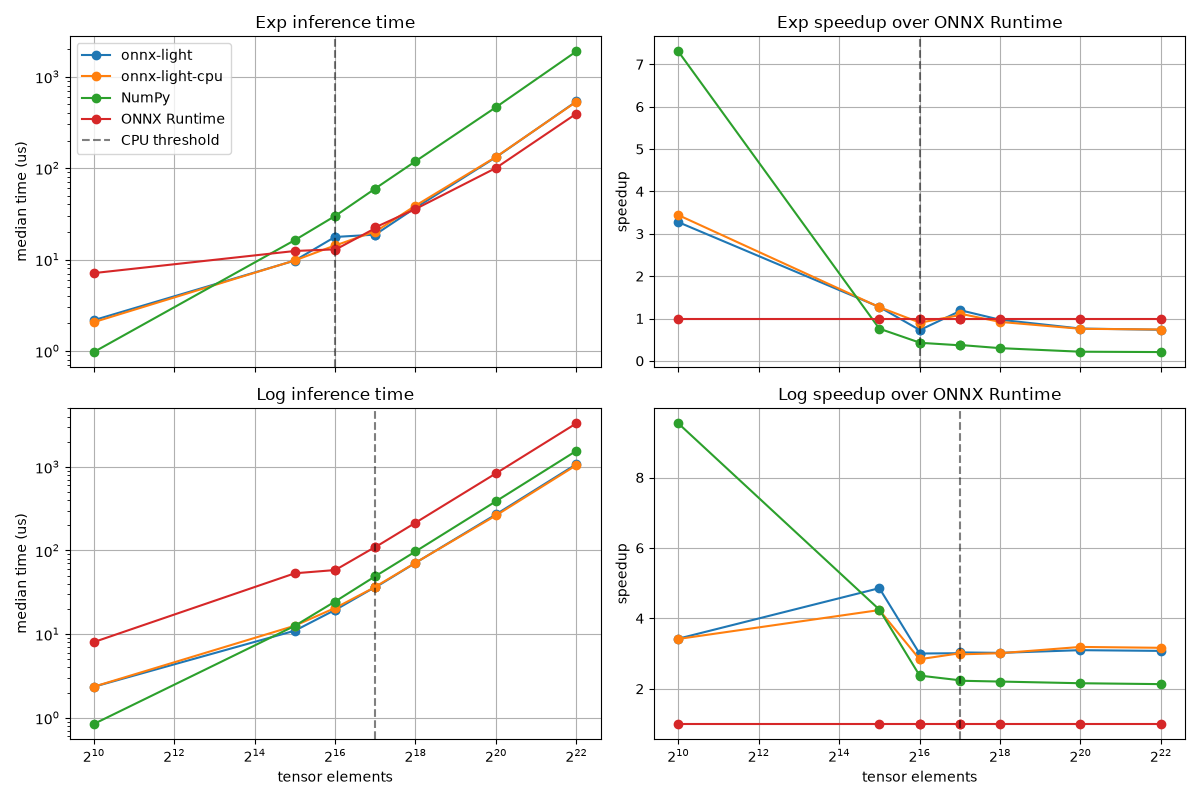
Exp:
  size=     1024 | numpy=      0.72 us | onnx-light=      1.82 us | onnx-light-cpu=      1.83 us | cpu vs built-in= 0.99x | onnxruntime=      5.32 us | cpu vs onnxruntime= 2.90x
  size=    65536 | numpy=     20.87 us | onnx-light=      6.90 us | onnx-light-cpu=      7.80 us | cpu vs built-in= 0.88x | onnxruntime=      9.34 us | cpu vs onnxruntime= 1.20x
  size=   131072 | numpy=     41.74 us | onnx-light=     11.39 us | onnx-light-cpu=     12.26 us | cpu vs built-in= 0.93x | onnxruntime=     11.87 us | cpu vs onnxruntime= 0.97x

Log:
  size=     1024 | numpy=      0.64 us | onnx-light=      2.03 us | onnx-light-cpu=      2.02 us | cpu vs built-in= 1.00x | onnxruntime=      6.40 us | cpu vs onnxruntime= 3.17x
  size=    65536 | numpy=     15.49 us | onnx-light=     22.88 us | onnx-light-cpu=     22.96 us | cpu vs built-in= 1.00x | onnxruntime=    104.34 us | cpu vs onnxruntime= 4.54x
  size=   131072 | numpy=     30.65 us | onnx-light=     23.76 us | onnx-light-cpu=     22.15 us | cpu vs built-in= 1.07x | onnxruntime=    205.91 us | cpu vs onnxruntime= 9.29x
import argparse
import gc
import os
import statistics
import time

import matplotlib.pyplot as plt
import numpy as np
import onnxruntime

from onnx_light.onnx import TensorProto, helper
from onnx_light.onnx.reference import ReferenceEvaluator
from onnx_light_cpu import register_kernels

parser = argparse.ArgumentParser(description=__doc__)
parser.add_argument("-r", "--repeat", type=int, default=10 * (os.cpu_count() or 1))
parser.add_argument("-w", "--warmup", type=int, default=2 * (os.cpu_count() or 1))
parser.add_argument("-t", "--max-repeat-time", type=float, default=1.0)
args, _ = parser.parse_known_args()
if args.repeat <= 0:
    parser.error("--repeat must be greater than 0")
if args.warmup < 0:
    parser.error("--warmup must be greater than or equal to 0")
if args.max_repeat_time <= 0:
    parser.error("--max-repeat-time must be greater than 0")


def make_model(op_type):
    """Creates a dynamic one-input ONNX model."""
    return helper.make_model(
        helper.make_graph(
            [helper.make_node(op_type, ["X"], ["Y"])],
            op_type,
            [helper.make_tensor_value_info("X", TensorProto.FLOAT, [None])],
            [helper.make_tensor_value_info("Y", TensorProto.FLOAT, [None])],
        ),
        opset_imports=[helper.make_opsetid("", 20)],
        ir_version=13,
    )


def make_ort_session(model, threads):
    """Creates a sequential ONNX Runtime session."""
    options = onnxruntime.SessionOptions()
    options.intra_op_num_threads = threads
    options.inter_op_num_threads = 1
    options.execution_mode = onnxruntime.ExecutionMode.ORT_SEQUENTIAL
    return onnxruntime.InferenceSession(
        model.SerializeToString(),
        sess_options=options,
        providers=["CPUExecutionProvider"],
    )


def measure(run, arrays, repeat, warmup, max_duration):
    """Measures median inference times for all arrays."""
    results = []
    for array in arrays:
        warmup_duration = 0.0
        for _ in range(warmup):
            begin = time.perf_counter()
            run(array)
            warmup_duration += time.perf_counter() - begin
            if warmup_duration >= max_duration:
                break
        samples = []
        total_duration = 0.0
        for _ in range(repeat):
            begin = time.perf_counter()
            run(array)
            duration = time.perf_counter() - begin
            samples.append(duration)
            total_duration += duration
            if total_duration >= max_duration:
                break
        results.append(statistics.median(samples))
    return np.array(results)


threads = min(4, os.cpu_count() or 1)
if os.environ.get("UNITTEST_GOING"):
    sizes = np.array([1024, 65536, 131072], dtype=np.int64)
else:
    sizes = np.array(
        [1024, 32768, 65535, 65536, 131071, 131072, 262144, 1048576, 4194304],
        dtype=np.int64,
    )

rng = np.random.default_rng(42)
exp_arrays = [rng.uniform(-4, 4, int(size)).astype(np.float32) for size in sizes]
log_arrays = [rng.uniform(0.01, 10, int(size)).astype(np.float32) for size in sizes]
models = {"Exp": make_model("Exp"), "Log": make_model("Log")}

# Sessions using the built-in kernels must be created before the global CPU
# kernel registration.
builtin_sessions = {op_type: ReferenceEvaluator(model) for op_type, model in models.items()}
for session in builtin_sessions.values():
    session.run(None, {"X": np.ones(1, dtype=np.float32)})

register_kernels()
cpu_sessions = {
    op_type: ReferenceEvaluator(
        model, cpu_execution={"num_threads": threads, "affinity_policy": "none"}
    )
    for op_type, model in models.items()
}

all_times = {op_type: {} for op_type in models}
for op_type, arrays in (("Exp", exp_arrays), ("Log", log_arrays)):
    builtin = builtin_sessions[op_type]
    cpu = cpu_sessions[op_type]
    numpy_op = np.exp if op_type == "Exp" else np.log
    expected = numpy_op(arrays[-1])
    np.testing.assert_allclose(
        builtin.run(None, {"X": arrays[-1]})[0], expected, rtol=2e-5, atol=2e-6
    )
    np.testing.assert_allclose(
        cpu.run(None, {"X": arrays[-1]})[0], expected, rtol=2e-5, atol=2e-6
    )
    all_times[op_type]["onnx-light"] = measure(
        lambda array, current=builtin: current.run(None, {"X": array}),
        arrays,
        args.repeat,
        args.warmup,
        args.max_repeat_time,
    )
    all_times[op_type]["onnx-light-cpu"] = measure(
        lambda array, current=cpu: current.run(None, {"X": array}),
        arrays,
        args.repeat,
        args.warmup,
        args.max_repeat_time,
    )

del builtin
del cpu
del builtin_sessions
del cpu_sessions
gc.collect()

for op_type, arrays in (("Exp", exp_arrays), ("Log", log_arrays)):
    numpy_op = np.exp if op_type == "Exp" else np.log
    all_times[op_type]["NumPy"] = measure(
        numpy_op, arrays, args.repeat, args.warmup, args.max_repeat_time
    )

ort_sessions = {op_type: make_ort_session(model, threads) for op_type, model in models.items()}
for op_type, arrays in (("Exp", exp_arrays), ("Log", log_arrays)):
    ort = ort_sessions[op_type]
    numpy_op = np.exp if op_type == "Exp" else np.log
    np.testing.assert_allclose(
        ort.run(None, {"X": arrays[-1]})[0],
        numpy_op(arrays[-1]),
        rtol=2e-5,
        atol=2e-6,
    )
    all_times[op_type]["ONNX Runtime"] = measure(
        lambda array, current=ort: current.run(None, {"X": array}),
        arrays,
        args.repeat,
        args.warmup,
        args.max_repeat_time,
    )

for op_type in ("Exp", "Log"):
    print(f"\n{op_type}:")
    for size, numpy_time, light_time, cpu_time, ort_time in zip(
        sizes,
        all_times[op_type]["NumPy"],
        all_times[op_type]["onnx-light"],
        all_times[op_type]["onnx-light-cpu"],
        all_times[op_type]["ONNX Runtime"],
        strict=True,
    ):
        cpu_speedup = light_time / cpu_time
        ort_speedup = ort_time / cpu_time
        print(
            f"  size={size:>9} | numpy={numpy_time * 1e6:10.2f} us | "
            f"onnx-light={light_time * 1e6:10.2f} us | "
            f"onnx-light-cpu={cpu_time * 1e6:10.2f} us | "
            f"cpu vs built-in={cpu_speedup:5.2f}x | "
            f"onnxruntime={ort_time * 1e6:10.2f} us | "
            f"cpu vs onnxruntime={ort_speedup:5.2f}x"
        )

fig, axes = plt.subplots(2, 2, figsize=(12, 8), sharex="col")
for row, op_type in enumerate(("Exp", "Log")):
    times = all_times[op_type]
    for label, values in times.items():
        axes[row, 0].plot(sizes, values * 1e6, marker="o", label=label)
        axes[row, 1].plot(sizes, times["ONNX Runtime"] / values, marker="o", label=label)
    threshold = 65536 if op_type == "Exp" else 131072
    for column in range(2):
        axes[row, column].axvline(
            threshold, color="black", linestyle="--", alpha=0.5, label="CPU threshold"
        )
        axes[row, column].set_xscale("log", base=2)
        axes[row, column].grid(True)
    axes[row, 0].set_yscale("log")
    axes[row, 0].set_title(f"{op_type} inference time")
    axes[row, 1].set_title(f"{op_type} speedup over ONNX Runtime")
    axes[row, 0].set_ylabel("median time (us)")
    axes[row, 1].set_ylabel("speedup")

axes[1, 0].set_xlabel("tensor elements")
axes[1, 1].set_xlabel("tensor elements")
axes[0, 0].legend()
plt.tight_layout()
fig.savefig("plot_exp_log_benchmark.png")
plt.show()
Total running time of the script: (0 minutes 0.546 seconds)