
Note
Go to the end to download the full example code.
Benchmark Abs: onnxruntime vs onnx-light + onnx-light-cpu#
This example compares up to four ways of computing the elementwise absolute value
of a float32 array across a range of input sizes:
onnxruntime - running a single-node
AbsONNX model.onnx-light + onnx-light-cpu - the SIMD-accelerated
Abskernel thatonnx-lightdispatches to. The same ONNX model used by onnxruntime is evaluated by anonnx-lightReferenceEvaluatoron which theonnx-light-cpuAbskernel has been registered (onnx_light_cpu.register_kernels()); the kernel provides runtime AVX-512/AVX2/AVX/SSE2 dispatch.onnx-light (built-in) -
onnx-light’s portableAbskernel, as a baseline for whatonnx-light-cpubuys on top of it. It is measured across the complete size grid.numpy -
numpy.abs(), used as a reference baseline.
The back-ends compute the same result; the goal here is to see how their timings evolve as the array grows from a few hundred to a hundred million elements.
Setup#
Report which SIMD level the current CPU provides. The mapping is 0=None,
1=SSE2, 2=AVX, 3=AVX2 and 4=AVX512.
import argparse
import gc
import os
import time

import numpy as np
import onnxruntime

# ``UNITTEST_GOING=1`` shrinks the benchmark (fewer/smaller sizes) so the example
# runs quickly as a unit test while still exercising every code path.
unit_test_going = os.environ.get("UNITTEST_GOING", "0") in ("1", "true", "True")

parser = argparse.ArgumentParser(description=__doc__)
parser.add_argument("-r", "--repeat", type=int, default=10 * (os.cpu_count() or 1))
parser.add_argument("-w", "--warmup", type=int, default=2 * (os.cpu_count() or 1))
parser.add_argument("-t", "--max-repeat-time", type=float, default=1.0)
args, _ = parser.parse_known_args()
if args.repeat <= 0:
    parser.error("--repeat must be greater than 0")
if args.warmup < 0:
    parser.error("--warmup must be greater than or equal to 0")
if args.max_repeat_time <= 0:
    parser.error("--max-repeat-time must be greater than 0")

# ``onnx-light`` ships ``onnx_light.onnx`` as a drop-in replacement for the
# ``onnx`` package; use it to build the model so the example depends on
# onnx-light rather than onnx.
from onnx_light.onnx import TensorProto, checker, helper
from onnx_light.onnx.reference import ReferenceEvaluator

from onnx_light_cpu import (
    clear_used_kernel_names,
    detect_simd_level,
    has_cpu_kernels,
    register_kernels,
    SimdLevel,
    set_kernel_usage_recording,
    used_kernel_names,
)

_SIMD_NAMES = {
    SimdLevel.NONE: "scalar",
    SimdLevel.SSE2: "SSE2",
    SimdLevel.AVX: "AVX",
    SimdLevel.AVX2: "AVX2",
    SimdLevel.AVX512: "AVX-512",
}

assert has_cpu_kernels()
level = detect_simd_level()
simd_name = _SIMD_NAMES.get(level, level)
print(f"CPU kernels available, SIMD level: {level} ({simd_name})")
CPU kernels available, SIMD level: 4 (AVX-512)
Sizes benchmarked#
size_grid = [100, 1000] if unit_test_going else [10**k for k in range(2, 9)]


def measure(
    func,
    repeat,
    warmup,
    number=1,
    max_duration=1.0,
):
    warmup_duration = 0.0
    for _ in range(warmup):
        start = time.perf_counter()
        func()
        warmup_duration += time.perf_counter() - start
        if warmup_duration >= max_duration:
            break
    timings = []
    total_duration = 0.0
    for _ in range(repeat):
        start = time.perf_counter()
        for _ in range(number):
            func()
        duration = time.perf_counter() - start
        timings.append(duration / number)
        total_duration += duration
        if total_duration >= max_duration:
            break
    return float(np.median(timings))
Prepare the built-in (un-accelerated) onnx-light Abs kernel#
onnx_light_cpu.register_kernels() permanently overrides the process-wide
Abs kernel entry, and a session only resolves/caches which kernel it
uses on its first run. This baseline therefore uses its own model/session
and runs once before register_kernels() is called below. Its cached
built-in kernel can then be timed in a separate phase on the same inputs.
alone_model = make_abs_model()
alone_session = ReferenceEvaluator(alone_model)
alone_label = "onnx-light (built-in)"
alone_session.run(None, {"X": np.zeros(1, dtype=np.float32)})
[array([0.], dtype=float32)]
Build the onnx-light evaluator#
onnx-light evaluates the same model with its C++ runtime. Registering the
onnx-light-cpu kernels overrides the built-in Abs so every Abs node in
the model dispatches to the SIMD-accelerated kernel.
light_label = "onnx-light + onnx-light-cpu"
# ``register_kernels()`` needs the ``_cpuregister`` extension, which is only
# built with ``ONNX_LIGHT_CPU_WITH_ONNX_LIGHT=ON``. When it is missing (as in
# the documentation build) the onnx-light-cpu curve is simply omitted; the
# import above stays unconditional.
_registration_start = time.perf_counter()
register_kernels()
registration_time = time.perf_counter() - _registration_start

_light_setup_start = time.perf_counter()
light_session = ReferenceEvaluator(model)
light_setup_time = time.perf_counter() - _light_setup_start
print(
    f"onnx-light session thread count: {light_session.cpu_execution_resolution.effective_threads}"
)

# Confirm the model dispatches to the onnx-light-cpu ``Abs`` kernel (identified
# by the library-qualified name it records when it runs) rather than
# onnx-light's built-in kernel.
clear_used_kernel_names()
light_session.run(None, {"X": np.zeros(1, dtype=np.float32)})
assert used_kernel_names() == ["onnx_light_cpu::Abs"], used_kernel_names()

# Verify the two lifetime domains directly. The NumPy input must remain a
# zero-copy borrowed tensor and consume no ExecutionArena slot, while the
# declared output is leased from the IOArena. Once the NumPy output is
# destroyed, a second run of the same shape must reuse the exact same retained
# output storage.
execution_arena = light_session._ctx.execution_allocator
io_arena = light_session._ctx.io_allocator
assert execution_arena is not io_arena
arena_probe = np.zeros(4096, dtype=np.float32)
probe_output = light_session.run(None, {"X": arena_probe})[0]
probe_address = probe_output.__array_interface__["data"][0]
assert io_arena.leased_count == 1
assert execution_arena.allocated_count == 0
assert execution_arena.total_allocated_size == 0
del probe_output
gc.collect()
assert io_arena.leased_count == 0
assert io_arena.retained_size >= arena_probe.nbytes
probe_output = light_session.run(None, {"X": arena_probe})[0]
assert probe_output.__array_interface__["data"][0] == probe_address
del probe_output
gc.collect()
print(
    "verified onnx-light arenas: distinct ExecutionArena/IOArena, "
    f"IO buffer reused at 0x{probe_address:x}; NumPy input is zero-copy"
)

# Usage recording is diagnostic instrumentation, not part of inference. It
# takes a mutex and appends to a process-wide log on every invocation, so leave
# it out of the timed region after confirming the expected kernel was selected.
set_kernel_usage_recording(False)


def run_light(inp):
    return light_session.run(None, {"X": inp})[0]
onnx-light session thread count: 2
verified onnx-light arenas: distinct ExecutionArena/IOArena, IO buffer reused at 0x563f0fcd02e0; NumPy input is zero-copy
Setup cost: ReferenceEvaluator stays lightweight#
Constructing an onnx-light ReferenceEvaluator is much faster than
constructing an onnxruntime.InferenceSession:
onnxruntimeparses the model and builds an optimized execution plan at construction time.onnx-lightonly creates lightweight persistent contexts inReferenceEvaluator.__init__. Execution-plan construction and kernel resolution remain lazy and are cached by the firstrun().
Kernel registration is process-wide and independent of evaluator construction,
so it is timed separately rather than incorrectly attributing its first-import
cost to ReferenceEvaluator.
print(f"setup: onnx-light ReferenceEvaluator = {light_setup_time * 1e3:.2f} ms")
print(f"setup: onnx-light-cpu kernel registration = {registration_time * 1e3:.2f} ms")
setup: onnx-light ReferenceEvaluator = 0.20 ms
setup: onnx-light-cpu kernel registration = 0.10 ms
Run the benchmark#
Every backend is measured in its own phase. Constructing ORT only after both onnx-light phases prevents its persistent worker pool from perturbing them. Likewise, the accelerated phase finishes before the built-in onnx-light pool is first used. Batched samples report steady-state time per inference.
rows_by_size = {size: [size, None, None, None, None] for size in size_grid}


def benchmark_phase(run, column, validate=True):
    rng = np.random.default_rng(0)
    for size in size_grid:
        inp = rng.uniform(-100.0, 100.0, size=size).astype(np.float32)
        number = max(1, min(20, 10_000_000 // size))
        rows_by_size[size][column] = measure(
            lambda inp=inp: run(inp),
            args.repeat,
            args.warmup,
            number=number,
            max_duration=args.max_repeat_time,
        )
        if validate:
            assert np.array_equal(run(inp), np.abs(inp)), size


benchmark_phase(np.abs, 1, validate=False)
benchmark_phase(run_light, 3)

set_kernel_usage_recording(True)
clear_used_kernel_names()
run_light(np.zeros(1, dtype=np.float32))
assert used_kernel_names() == ["onnx_light_cpu::Abs"], used_kernel_names()
set_kernel_usage_recording(False)

benchmark_phase(lambda inp: alone_session.run(None, {"X": inp})[0], 2)

plot_light_results = light_session is not None
light_session = None
alone_session = None
gc.collect()

_ort_setup_start = time.perf_counter()
session = onnxruntime.InferenceSession(model_bytes, providers=["CPUExecutionProvider"])
ort_setup_time = time.perf_counter() - _ort_setup_start
print(f"setup: onnxruntime InferenceSession = {ort_setup_time * 1e3:.2f} ms")
benchmark_phase(lambda inp: session.run(None, {"X": inp})[0], 4)

rows = [tuple(rows_by_size[size]) for size in size_grid]
for size, numpy_time, alone_time, cpu_time, ort_time in rows:
    cpu_speedup = alone_time / cpu_time
    ort_speedup = ort_time / cpu_time
    print(
        f"size={size:>9} | numpy={numpy_time * 1e6:10.2f} us | "
        f"onnx-light={alone_time * 1e6:10.2f} us | "
        f"onnx-light-cpu={cpu_time * 1e6:10.2f} us | "
        f"cpu vs built-in={cpu_speedup:5.2f}x | "
        f"onnxruntime={ort_time * 1e6:10.2f} us | "
        f"cpu vs onnxruntime={ort_speedup:5.2f}x"
    )

set_kernel_usage_recording(True)
print("verified onnx-light-cpu Abs dispatch")

sizes = np.array([r[0] for r in rows])
numpy_times = np.array([r[1] for r in rows])
alone_times = np.array([r[2] for r in rows])
cpu_times = np.array([r[3] for r in rows])
ort_times = np.array([r[4] for r in rows])
setup: onnxruntime InferenceSession = 1.34 ms
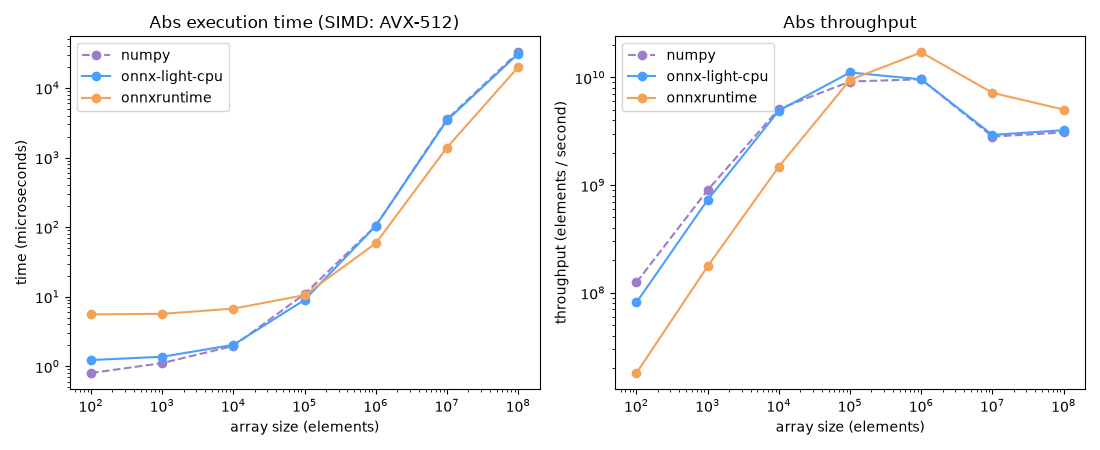
size=      100 | numpy=      0.37 us | onnx-light=      1.75 us | onnx-light-cpu=      1.74 us | cpu vs built-in= 1.01x | onnxruntime=      5.95 us | cpu vs onnxruntime= 3.43x
size=     1000 | numpy=      0.55 us | onnx-light=      1.80 us | onnx-light-cpu=      1.80 us | cpu vs built-in= 1.00x | onnxruntime=      6.03 us | cpu vs onnxruntime= 3.36x
size=    10000 | numpy=      1.22 us | onnx-light=      2.51 us | onnx-light-cpu=      2.54 us | cpu vs built-in= 0.99x | onnxruntime=      7.09 us | cpu vs onnxruntime= 2.79x
size=   100000 | numpy=      7.64 us | onnx-light=      6.67 us | onnx-light-cpu=      6.44 us | cpu vs built-in= 1.04x | onnxruntime=     11.07 us | cpu vs onnxruntime= 1.72x
size=  1000000 | numpy=     82.24 us | onnx-light=     51.09 us | onnx-light-cpu=     48.78 us | cpu vs built-in= 1.05x | onnxruntime=     59.61 us | cpu vs onnxruntime= 1.22x
size= 10000000 | numpy=   3034.18 us | onnx-light=   1442.49 us | onnx-light-cpu=   1447.59 us | cpu vs built-in= 1.00x | onnxruntime=   1523.89 us | cpu vs onnxruntime= 1.05x
size=100000000 | numpy=  32444.77 us | onnx-light=  20902.57 us | onnx-light-cpu=  20727.60 us | cpu vs built-in= 1.01x | onnxruntime=  20542.35 us | cpu vs onnxruntime= 0.99x
verified onnx-light-cpu Abs dispatch
Plot the timings#
The left panel shows the raw execution time versus the array size on a
log-log scale. The right panel shows the speed-up relative to
onnxruntime (the baseline): for each back-end the onnxruntime time is
divided by the back-end time, so values above 1 are faster than
onnxruntime and values below 1 are slower. The onnxruntime curve is a
flat line at 1 by construction. The speed-up panel uses a logarithmic
y-axis so that a given ratio and its reciprocal are equidistant from the
1 baseline.
import matplotlib.pyplot as plt

fig, (ax_time, ax_speedup) = plt.subplots(1, 2, figsize=(12, 4.5))

ax_time.plot(sizes, numpy_times * 1e6, "o--", label="numpy", color="#9b7ec8")
if plot_light_results:
    ax_time.plot(
        sizes,
        cpu_times * 1e6,
        "o-",
        label=light_label,
        color="#4a9eff",
    )
ax_time.plot(
    sizes,
    alone_times * 1e6,
    "o--",
    label=alone_label,
    color="#5cb85c",
)
ax_time.plot(sizes, ort_times * 1e6, "o-", label="onnxruntime", color="#f4a259")
ax_time.set_xscale("log")
ax_time.set_yscale("log")
ax_time.set_xlabel("array size (elements)")
ax_time.set_ylabel("time (microseconds)")
ax_time.set_title(f"Abs execution time (SIMD: {simd_name})")
ax_time.tick_params(axis="x", labelrotation=45)
ax_time.legend()

ax_speedup.plot(sizes, ort_times / numpy_times, "o--", label="numpy", color="#9b7ec8")
if plot_light_results:
    cpu_speedup = ort_times / cpu_times
    ax_speedup.plot(
        sizes,
        cpu_speedup,
        "o-",
        label=light_label,
        color="#4a9eff",
    )
    for size, speedup in zip(sizes, cpu_speedup, strict=True):
        ax_speedup.annotate(
            f"{speedup:.2f}x",
            (size, speedup),
            xytext=(0, 7),
            textcoords="offset points",
            ha="center",
            fontsize=8,
            color="#4a9eff",
        )
ax_speedup.plot(
    sizes,
    ort_times / alone_times,
    "o--",
    label=alone_label,
    color="#5cb85c",
)
ax_speedup.plot(sizes, ort_times / ort_times, "o-", label="onnxruntime", color="#f4a259")
ax_speedup.axhline(1.0, color="grey", linewidth=0.8, linestyle=":")
ax_speedup.set_xscale("log")
ax_speedup.set_yscale("log")
ax_speedup.set_xlabel("array size (elements)")
ax_speedup.set_ylabel("speed-up vs onnxruntime")
ax_speedup.set_title("Abs speed-up (onnxruntime = 1)")
ax_speedup.tick_params(axis="x", labelrotation=45)
ax_speedup.legend()

fig.tight_layout()
fig.savefig("plot_abs_benchmark.png")
plt.show()
Total running time of the script: (0 minutes 7.549 seconds)