
Note
Go to the end to download the full example code.
Extend ReferenceEvaluator with a custom kernel#
ReferenceEvaluator dispatches every
NodeProto against the static C++ KernelDispatchTable. Any operator
that is not built in — typically an operator from a user-defined domain,
or a temporary stand-in for an op that is not yet implemented — would
otherwise fail with unsupported op_type.
The
register_custom_kernel()
hook makes it possible to plug a Python callable into the runtime without
touching the C++ dispatch table. The callable is invoked as
fn(node, *numpy_inputs) and must return either a single
numpy.ndarray or a tuple/list of arrays for multi-output ops.
Registrations are reapplied to the fresh RuntimeContext built on
every run() call, so
the same evaluator can be reused safely across runs.
This example:
parses a small ONNX graph that calls
my.domain.Scale— an operator that is not part of the built-in dispatch table,registers a numpy-friendly Python implementation through
register_custom_kernel(),runs the model and prints the result.
from __future__ import annotations

import numpy as np

from onnx_light.onnx_lib import parser
from onnx_light.onnx.reference import ReferenceEvaluator
Build a model that uses a custom op#
my.domain.Scale is a user-defined operator: it multiplies its
single input by a factor attribute. The ONNX parser accepts the
unknown op as long as the domain is declared in opset_import.
model = parser.parse_model(
    '<ir_version: 10, opset_import: ["" : 18, "my.domain" : 1]>'
    "agraph (float[3] x) => (float[3] y) {"
    "  y = my.domain.Scale<factor=3.0>(x)"
    "}"
)
print(model)
{ ir_version: 10 opset_import: [ { version: 18 } { domain: "my.domain" version: 1 } ] graph: { name: "agraph" input: [ { name: "x" type: { tensor_type: { elem_type: 1 shape: { dim: [ { dim_value: 3 } ] } } } } ] output: [ { name: "y" type: { tensor_type: { elem_type: 1 shape: { dim: [ { dim_value: 3 } ] } } } } ] node: [ { input: ["x"] output: ["y"] op_type: "Scale" attribute: [ { factor: 3 } ] domain: "my.domain" } ] } }
Implement the custom kernel#
The callable receives the NodeProto (so it can read attributes)
followed by one numpy.ndarray per declared input. It returns either
a single array or a tuple/list of arrays — one per declared output.
Register and run#
register_custom_kernel() is a wrapper around the low-level
RuntimeContext.register_custom_kernel() binding. The
registration is stored on the evaluator and reapplied to every
fresh RuntimeContext it builds, so the same evaluator can
run multiple inputs without re-registering.
y = [3. 6. 9.]
Overriding a built-in kernel#
A custom registration under the default ONNX domain takes precedence
over the entry that KernelDispatchTable would otherwise dispatch.
This is convenient to instrument or replace a specific kernel without
patching the C++ runtime. Below Abs is replaced by negation just
to demonstrate the override mechanism.
override_model = parser.parse_model(
    '<ir_version: 10, opset_import: ["" : 18]>'
    "agraph (float[3] x) => (float[3] y) { y = Abs(x) }"
)


def fake_abs(node, x):
    return -x


sess2 = ReferenceEvaluator(override_model)
sess2.register_custom_kernel("", "Abs", fake_abs)
(y2,) = sess2.run(None, {"x": np.array([-1.0, -2.0, -3.0], dtype=np.float32)})
print(f"Abs replaced by negation: y = {y2}")
Abs replaced by negation: y = [1. 2. 3.]
See also#
Custom kernels for ReferenceEvaluator for the design notes, including the matching low-level Python (
RuntimeContext.register_custom_kernel) and C++ (RuntimeContext::RegisterCustomKernel) entry points.
Total running time of the script: (0 minutes 0.004 seconds)
Related examples
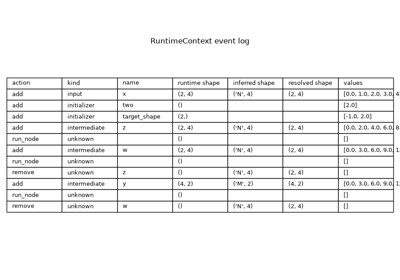
Run a model with the runtime and inspect intermediate results
Run an ONNX model casting a float tensor into an int2 tensor
Retrieve a backend test case and display its model and data