
Note
Go to the end to download the full example code.
Benchmark Log: built-in and custom operators#
Compare synchronous CPU calls to Log using NumPy, ORT’s built-in operator,
and the onnx_light_cpu custom operator (not an execution provider).
Two graph topologies are used: X -> Log -> Y and
X -> Log -> ... -> Log -> Y with ten consecutive nodes. Both use float32,
dynamic one-dimensional inputs and models built with onnx_light.onnx.
ORT executes each topology with either standard-domain or custom-domain nodes,
using all four synchronous Python calling interfaces: run,
run_with_ort_values, run_with_iobinding and run_with_ortvaluevector.
The standalone onnx-light custom-op host exposes only run and accepts only
one node. Its ten-node result is therefore unavailable, not ten Python calls
misrepresented as a graph. NumPy provides a baseline with one or ten ufunc calls.
Repeated real-valued logarithms inevitably leave the positive domain in float32. The ten-node graph produces NaNs: this is a literal Log chain, not a benchmark of ten finite-input logarithms. Every path is checked against a NumPy reference, including matching NaNs, before and after timing.
import argparse
from functools import partial
import inspect
import json
import os
from pathlib import Path
import platform
import statistics
import subprocess
import sys
import time

import numpy
from onnx_light.onnx import TensorProto, checker, helper
Construct both graph topologies here, so the downloaded gallery example contains the complete benchmark, including its isolated worker.
def make_model(custom, nodes=1):
    domain = "onnx_light_cpu" if custom else ""
    names = ["X", *(f"log_{index}" for index in range(1, nodes)), "Y"]
    model = helper.make_model(
        helper.make_graph(
            [
                helper.make_node("Log", [names[index]], [names[index + 1]], domain=domain)
                for index in range(nodes)
            ],
            "log-custom-op-benchmark",
            [helper.make_tensor_value_info("X", TensorProto.FLOAT, ["N"])],
            [helper.make_tensor_value_info("Y", TensorProto.FLOAT, ["N"])],
        ),
        opset_imports=[helper.make_opsetid(domain, 1 if custom else 18)],
        ir_version=9,
    )
    checker.check_model(model)
    return model.SerializeToString()


def numpy_log(values, nodes):
    for _ in range(nodes):
        values = numpy.log(values)
    return values
Prepare reusable inputs and outputs before timing each ORT calling interface. Import ORT only inside these functions: standalone workers must not load it.
def ort_runner(session, values, api):
    """Prepares reusable inputs and outputs outside the measured region."""
    import onnxruntime

    feeds = {"X": values}
    if api == "run":
        return lambda: session.run(["Y"], feeds), lambda result: result[0]
    input_value = onnxruntime.OrtValue.ortvalue_from_numpy(values)
    if api == "ortvalues":
        feeds = {"X": input_value}
        return (
            lambda: session.run_with_ort_values(["Y"], feeds),
            lambda result: result[0].numpy(),
        )
    output = numpy.empty_like(values)
    output_value = onnxruntime.OrtValue.ortvalue_from_numpy(output)
    if api == "iobinding":
        binding = session.io_binding()
        binding.bind_ortvalue_input("X", input_value)
        binding.bind_ortvalue_output("Y", output_value)
        return lambda: session.run_with_iobinding(binding), lambda result: output
    if api != "ortvaluevector":
        raise ValueError(f"Unsupported ORT API: {api}")
    from onnxruntime.capi import _pybind_state as C

    inputs = C.OrtValueVector()
    inputs.push_back(input_value._get_c_value())
    outputs = C.OrtValueVector()
    outputs.push_back(output_value._get_c_value())
    devices = [C.OrtDevice(C.OrtDevice.cpu(), C.OrtDevice.default_memory(), 0)]
    options = onnxruntime.RunOptions()
    input_names, output_names = ["X"], ["Y"]
    return (
        lambda: session.run_with_ortvaluevector(
            options, input_names, inputs, output_names, outputs, devices
        ),
        lambda result: output,
    )
Check each path against NumPy before and after collecting its timing samples.
def measure(args):
    if args.backend == "standalone" and (args.nodes != 1 or args.api != "run"):
        raise ValueError("The standalone host supports only one node and the run API")
    custom = args.backend != "ort"
    if args.backend == "standalone":
        from onnx_light_ort import CustomOpSession

        session = CustomOpSession(
            make_model(custom, args.nodes), library=args.library, host_library=args.host
        )
        version = None
    elif args.backend == "numpy":
        version = None
    else:
        import onnxruntime

        options = onnxruntime.SessionOptions()
        options.intra_op_num_threads = 1
        options.inter_op_num_threads = 1
        options.execution_mode = onnxruntime.ExecutionMode.ORT_SEQUENTIAL
        if custom:
            options.register_custom_ops_library(str(args.library))
        session = onnxruntime.InferenceSession(
            make_model(custom, args.nodes), options, providers=["CPUExecutionProvider"]
        )
        version = onnxruntime.__version__

    rng = numpy.random.default_rng(42)
    rows = []
    for size in args.sizes:
        values = rng.uniform(0.01, 10, size).astype(numpy.float32)
        feeds = {"X": values}
        if args.backend == "standalone":
            run, get_output = partial(session.run, None, feeds), lambda result: result[0]
        elif args.backend == "numpy":
            run = partial(numpy_log, values, args.nodes)

            def get_output(result):
                return result

        else:
            run, get_output = ort_runner(session, values, args.api)
        # Repeated real-valued logarithms eventually leave the positive domain.
        with numpy.errstate(divide="ignore", invalid="ignore"):
            expected = values.copy()
            for _ in range(args.nodes):
                expected = numpy.log(expected.astype(numpy.float64)).astype(numpy.float32)
            for _ in range(args.warmup):
                run()
            numpy.testing.assert_allclose(
                get_output(run()), expected, rtol=2e-6, atol=0, equal_nan=True
            )
            samples = []
            for _ in range(args.repeat):
                begin = time.perf_counter()
                for _ in range(args.number):
                    run()
                samples.append((time.perf_counter() - begin) / args.number)
            numpy.testing.assert_allclose(
                get_output(run()), expected, rtol=2e-6, atol=0, equal_nan=True
            )
        rows.append({"size": size, "samples_s": samples})

    if args.backend == "standalone":
        session.close()
        assert "onnxruntime" not in sys.modules
    assert "onnx" not in sys.modules
    return {
        "backend": args.backend,
        "api": args.api,
        "nodes": args.nodes,
        "ort_version": version,
        "rows": rows,
    }
The command-line entry point also serves isolated measurement workers.
def main():
    parser = argparse.ArgumentParser(description=__doc__)
    parser.add_argument("--library", type=Path, required=True)
    parser.add_argument("--host", type=Path, required=True)
    parser.add_argument(
        "--sizes", type=int, nargs="+", default=[1024, 32768, 65536, 262144, 1048576]
    )
    parser.add_argument("--warmup", type=int, default=10)
    parser.add_argument("--repeat", type=int, default=31)
    parser.add_argument("--number", type=int, default=20)
    parser.add_argument("--trials", type=int, default=3)
    parser.add_argument("--nodes", type=int, choices=[1, 10], default=1)
    parser.add_argument(
        "--api", choices=["run", "ortvalues", "iobinding", "ortvaluevector"], default="run"
    )
    parser.add_argument("--output", type=Path)
    parser.add_argument(
        "--backend", choices=["ort", "custom", "standalone", "numpy"], help=argparse.SUPPRESS
    )
    args = parser.parse_args()
    if min(args.sizes) <= 0 or max(args.sizes) > 16 * 1024 * 1024:
        parser.error("sizes must be positive and fit the host's 64 MiB tensor limit")
    if min(args.repeat, args.number, args.trials) <= 0 or args.warmup < 0:
        parser.error("repeat, number and trials must be positive; warmup must be nonnegative")
    args.library = args.library.resolve(strict=True)
    args.host = args.host.resolve(strict=True)
    if args.backend:
        print(json.dumps(measure(args)))
        return

    backends = ["ort", "custom"]
    if args.nodes == 1 and args.api == "run":
        backends.append("standalone")
    results = []
    for trial in range(args.trials):
        offset = trial % len(backends)
        for backend in backends[offset:] + backends[:offset]:
            command = [
                sys.executable,
                str(Path(inspect.getsourcefile(main)).resolve()),
                "--library",
                str(args.library),
                "--host",
                str(args.host),
                "--sizes",
                *(str(size) for size in args.sizes),
                "--warmup",
                str(args.warmup),
                "--repeat",
                str(args.repeat),
                "--number",
                str(args.number),
                "--backend",
                backend,
                "--nodes",
                str(args.nodes),
                "--api",
                args.api,
            ]
            completed = subprocess.run(command, check=True, stdout=subprocess.PIPE, text=True)
            results.append(json.loads(completed.stdout))

    report = {
        "measurement": f"steady-state {args.api}; includes Python interfaces",
        "nodes": args.nodes,
        "threads": 1,
        "operator": "Log",
        "dtype": "float32",
        "input_distribution": "uniform(0.01, 10), NumPy default_rng seed 42",
        "platform": platform.platform(),
        "affinity": sorted(os.sched_getaffinity(0)) if hasattr(os, "sched_getaffinity") else None,
        "python": platform.python_version(),
        "warmup": args.warmup,
        "repeat": args.repeat,
        "number": args.number,
        "trials": args.trials,
        "results": results,
    }
    if args.output:
        args.output.write_text(json.dumps(report, indent=2) + "\n", encoding="utf-8")
    standalone = " CPU custom op / standalone (us) |" if "standalone" in backends else ""
    print(f"| Elements | ORT Log (us) | CPU custom op / ORT (us) | Speedup |{standalone}")
    print("| ---: | ---: | ---: | ---: |" + (" ---: |" if standalone else ""))
    for index, size in enumerate(args.sizes):
        times = {}
        for backend in backends:
            samples = [
                value
                for result in results
                if result["backend"] == backend
                for value in result["rows"][index]["samples_s"]
            ]
            times[backend] = statistics.median(samples)
        standalone_time = f" {times['standalone'] * 1e6:.3f} |" if standalone else ""
        print(
            f"| {size:,} | {times['ort'] * 1e6:.3f} | {times['custom'] * 1e6:.3f} "
            f"| {times['ort'] / times['custom']:.2f}x |{standalone_time}"
        )
    print(
        "Raw samples, when --output is supplied, include all trials; "
        "standalone timings include protective input and output copies."
    )
Each measurement runs in a fresh process so the standalone host never imports or loads ORT. Library paths are explicit, just like the other gallery examples. Sessions, random inputs (seed 42), OrtValues, bindings and preallocated outputs are prepared outside timing. ORT uses one thread and sequential execution. Each path gets three warmups and five batches of ten calls; report the median time per whole graph, not per node. Correctness checks and output conversion to NumPy are excluded from timing.
run and run_with_ort_values allocate outputs; I/O binding and
run_with_ortvaluevector reuse preallocated output buffers. The standalone
wrapper includes protective input and output copies. These are end-to-end
Python interface timings, not isolated kernel timings or universal speedups.
def run_gallery():
    benchmark = Path(inspect.getsourcefile(run_gallery)).resolve()
    root = benchmark.parents[2]
    environment = os.environ.copy()
    environment["PYTHONPATH"] = os.pathsep.join([str(root), os.environ.get("PYTHONPATH", "")])
    launcher = [sys.executable]
    if sys.platform == "win32":
        launcher.append(str(root / "cmake/run_python_with_dll_paths.py"))
    library = Path(os.environ["ONNX_LIGHT_ORT_PLUGIN_LIBRARY"]).resolve(strict=True)
    host = Path(os.environ["ONNX_LIGHT_ORT_HOST_LIBRARY"]).resolve(strict=True)
    sizes = [1, 1024, 65536]
    apis = ["run", "ortvalues", "iobinding", "ortvaluevector"]
    paths = [
        ("numpy", "run"),
        ("standalone", "run"),
        *((backend, api) for backend in ("ort", "custom") for api in apis),
    ]
    print(f"Python {platform.python_version()}, {platform.platform()}")
    results = []
    for nodes in (1, 10):
        print(f"\n{nodes} Log node(s), median microseconds per graph")
        print(f"{'Backend / API':<34}" + "".join(f"{size:>14,}" for size in sizes))
        for backend, api in paths:
            label = f"{backend} / {api}"
            if backend == "standalone" and nodes != 1:
                print(f"{label:<34}  unavailable (single-node host)")
                continue
            command = [
                *launcher,
                str(benchmark),
                "--library",
                str(library),
                "--host",
                str(host),
                "--sizes",
                *(str(size) for size in sizes),
                "--nodes",
                str(nodes),
                "--api",
                api,
                "--backend",
                backend,
                "--warmup",
                "3",
                "--repeat",
                "5",
                "--number",
                "10",
            ]
            completed = subprocess.run(
                command, check=True, stdout=subprocess.PIPE, text=True, env=environment
            )
            result = json.loads(completed.stdout)
            results.append(result)
            times = [statistics.median(row["samples_s"]) * 1e6 for row in result["rows"]]
            print(f"{label:<34}" + "".join(f"{value:>14.3f}" for value in times))
    ort_version = next(result["ort_version"] for result in results if result["backend"] == "ort")
    print(f"\nONNX Runtime {ort_version}; NumPy and onnx-light model bindings; float32 CPU")
    assert "onnx" not in sys.modules
    return results
The full samples remain available in results. No performance thresholds
are asserted: CPU, SIMD dispatch and ORT version affect these measurements.
if __name__ == "__main__":
    if "__file__" in globals() and len(sys.argv) > 1:
        main()
    else:
        results = run_gallery()

        # %%
        # Compare whole-graph latency for every backend and calling interface.
        import matplotlib.pyplot as plt

        fig, axes = plt.subplots(1, 2, figsize=(14, 5), sharey=True)
        labels = list(dict.fromkeys(f"{r['backend']} / {r['api']}" for r in results))
        for ax, nodes in zip(axes, (1, 10), strict=True):
            for result in results:
                if result["nodes"] != nodes:
                    continue
                label = f"{result['backend']} / {result['api']}"
                ax.plot(
                    [row["size"] for row in result["rows"]],
                    [statistics.median(row["samples_s"]) * 1e6 for row in result["rows"]],
                    marker="o",
                    label=label,
                    color=f"C{labels.index(label)}",
                )
            ax.set(
                title=f"{nodes} Log node(s)",
                xlabel="Input elements",
                xscale="log",
                yscale="log",
            )
            ax.grid(True)
        axes[0].set_ylabel("Median latency per graph (µs)")
        axes[1].legend(
            *axes[0].get_legend_handles_labels(), loc="upper left", bbox_to_anchor=(1, 1)
        )
        fig.tight_layout()
        plt.show()
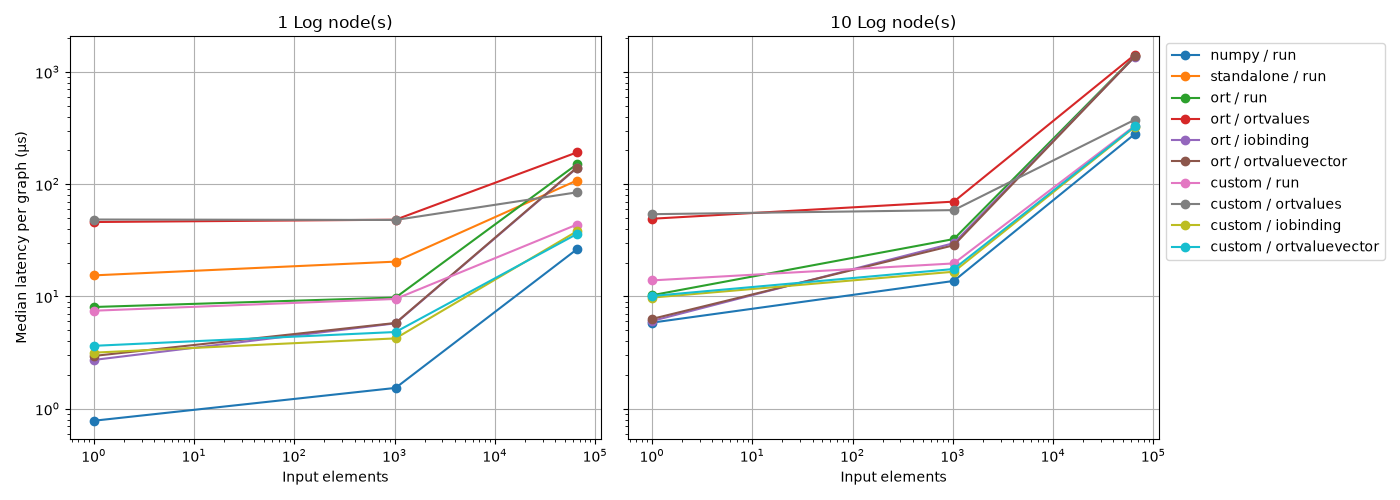
Python 3.12.15, Linux-6.17.0-1022-azure-x86_64-with-glibc2.39

1 Log node(s), median microseconds per graph
Backend / API                                  1         1,024        65,536
numpy / run                                0.782         1.533        26.222
standalone / run                          15.408        20.431       107.695
ort / run                                  8.055         9.777       150.057
ort / ortvalues                           46.023        48.267       191.544
ort / iobinding                            2.720         5.765       138.718
ort / ortvaluevector                       2.951         5.805       140.044
custom / run                               7.463         9.498        43.590
custom / ortvalues                        48.461        48.008        84.551
custom / iobinding                         3.158         4.231        37.968
custom / ortvaluevector                    3.632         4.824        35.909

10 Log node(s), median microseconds per graph
Backend / API                                  1         1,024        65,536
numpy / run                                5.845        13.749       280.501
standalone / run                    unavailable (single-node host)
ort / run                                 10.252        32.462      1378.867
ort / ortvalues                           49.230        69.939      1425.298
ort / iobinding                            6.046        29.847      1370.866
ort / ortvaluevector                       6.307        28.579      1374.045
custom / run                              13.900        19.688       331.857
custom / ortvalues                        54.046        58.760       375.599
custom / iobinding                         9.767        16.608       324.461
custom / ortvaluevector                   10.095        17.559       327.461

ONNX Runtime 1.31.0; NumPy and onnx-light model bindings; float32 CPU
Total running time of the script: (0 minutes 5.550 seconds)