Note
Go to the end to download the full example code.
Comparing the five ONNX translation APIs#
translate converts an
onnx.ModelProto into Python source code that, when executed,
recreates the same model. Five output APIs are available:
"onnx"— usesonnx.helper(oh.make_node,oh.make_graph, …) viaInnerEmitter."onnx-short"— same as"onnx"but replaces large initializers with random values to keep the snippet compact, viaInnerEmitterShortInitializer."onnx-compact"— produces a single nested expression instead of assembling separate lists of nodes/inputs/outputs, viaInnerEmitterCompact."light"— fluentstart(…).vin(…).…chain, viaLightEmitter."builder"—GraphBuilder-based function wrapper, viaBuilderEmitter.
This example builds a small model, translates it with every API, shows the
generated code, and verifies that the "onnx" snippet can be re-executed to
reproduce the original model.
import numpy as np
import onnx
import onnx.helper as oh
import onnx.numpy_helper as onh
from yobx.translate import translate, translate_header
Build the model#
We use Z = Relu(X @ W + b) as a running example:
a single Gemm followed by Relu.
TFLOAT = onnx.TensorProto.FLOAT
INT64 = onnx.TensorProto.INT64

W = onh.from_array(np.random.randn(8, 5).astype(np.float32), name="W")
b = onh.from_array(np.random.randn(5).astype(np.float32), name="b")

model = oh.make_model(
    oh.make_graph(
        [oh.make_node("Gemm", ["X", "W", "b"], ["T"]), oh.make_node("Relu", ["T"], ["Z"])],
        "gemm_relu",
        [oh.make_tensor_value_info("X", TFLOAT, [None, 8])],
        [oh.make_tensor_value_info("Z", TFLOAT, [None, 5])],
        [W, b],
    ),
    opset_imports=[oh.make_opsetid("", 17)],
    ir_version=9,
)

print(f"Model: {len(model.graph.node)} node(s), {len(model.graph.initializer)} initializer(s)")
Model: 2 node(s), 2 initializer(s)
1. "onnx" API — full initializer values#
The generated code uses onnx.helper.make_node(),
onnx.helper.make_graph(), and onnx.helper.make_model().
Every initializer is serialised as an exact np.array(…) literal.
=== api='onnx' ===
opset_imports = [
    oh.make_opsetid('', 17),
]
inputs = []
outputs = []
nodes = []
initializers = []
sparse_initializers = []
functions = []
initializers.append(
    onh.from_array(
        np.array([[-2.8501951694488525, -0.5612078309059143, 1.0888885259628296, 0.836222767829895, 0.8602944612503052], [-0.5604823231697083, -2.19199800491333, -0.6678777933120728, -0.6487101316452026, 0.08450940251350403], [0.8968738913536072, 1.1287903785705566, 0.3421708643436432, 0.5692922472953796, -0.4278814196586609], [-0.09210827946662903, -0.9187420606613159, 0.13873837888240814, -1.5727717876434326, -0.10080558061599731], [0.21605294942855835, 0.6848098635673523, 0.007529611699283123, -2.1378822326660156, 0.5840367674827576], [2.7655389308929443, -1.927566647529602, -0.7800881862640381, 0.20291732251644135, -1.607230544090271], [0.23991000652313232, -1.0260566473007202, 0.4492259919643402, 2.119370937347412, 0.6684412360191345], [-1.208194375038147, 1.9516820907592773, 1.0205625295639038, -0.8302878737449646, -1.3480478525161743]], dtype=np.float32),
        name='W'
    )
)
initializers.append(
    onh.from_array(
        np.array([-1.2197785377502441, -1.8406898975372314, -2.3381173610687256, -1.5528756380081177, -0.1304451823234558], dtype=np.float32),
        name='b'
    )
)
inputs.append(oh.make_tensor_value_info('X', onnx.TensorProto.FLOAT, shape=(None, 8)))
nodes.append(
    oh.make_node(
        'Gemm',
        ['X', 'W', 'b'],
        ['T']
    )
)
nodes.append(
    oh.make_node(
        'Relu',
        ['T'],
        ['Z']
    )
)
outputs.append(oh.make_tensor_value_info('Z', onnx.TensorProto.FLOAT, shape=(None, 5)))
graph = oh.make_graph(
    nodes,
    'gemm_relu',
    inputs,
    outputs,
    initializers,
    sparse_initializer=sparse_initializers,
)
model = oh.make_model(
    graph,
    functions=functions,
    opset_imports=opset_imports,
    ir_version=9,
)
2. "onnx-short" API — large initializers replaced by random values#
Identical to "onnx" except that initializers with more than 16 elements
are replaced by np.random.randn(…) / np.random.randint(…) calls.
This keeps the snippet readable when dealing with large weight tensors.
code_short = translate(model, api="onnx-short")
print("=== api='onnx-short' ===")
print(code_short)
=== api='onnx-short' ===
opset_imports = [
    oh.make_opsetid('', 17),
]
inputs = []
outputs = []
nodes = []
initializers = []
sparse_initializers = []
functions = []
value = np.random.randn(8, 5).astype(np.float32)
initializers.append(
    onh.from_array(
        np.array(value, dtype=np.float32),
        name='W'
    )
)
initializers.append(
    onh.from_array(
        np.array([-1.2197785377502441, -1.8406898975372314, -2.3381173610687256, -1.5528756380081177, -0.1304451823234558], dtype=np.float32),
        name='b'
    )
)
inputs.append(oh.make_tensor_value_info('X', onnx.TensorProto.FLOAT, shape=(None, 8)))
nodes.append(
    oh.make_node(
        'Gemm',
        ['X', 'W', 'b'],
        ['T']
    )
)
nodes.append(
    oh.make_node(
        'Relu',
        ['T'],
        ['Z']
    )
)
outputs.append(oh.make_tensor_value_info('Z', onnx.TensorProto.FLOAT, shape=(None, 5)))
graph = oh.make_graph(
    nodes,
    'gemm_relu',
    inputs,
    outputs,
    initializers,
    sparse_initializer=sparse_initializers,
)
model = oh.make_model(
    graph,
    functions=functions,
    opset_imports=opset_imports,
    ir_version=9,
)
Size comparison between the two onnx variants:
print(f"\nFull code length  : {len(code_onnx):>6} characters")
print(f"Short code length : {len(code_short):>6} characters")
Full code length  :   1899 characters
Short code length :   1116 characters
3. "onnx-compact" API — single nested expression#
Instead of building separate lists of nodes, inputs, outputs, and initializers
before assembling them, this emitter produces a single nested
oh.make_model(oh.make_graph([…], …), …) expression.
This is often more concise than "onnx" while still being fully readable.
code_compact = translate(model, api="onnx-compact")
print("=== api='onnx-compact' ===")
print(code_compact)
=== api='onnx-compact' ===
model = oh.make_model(
    oh.make_graph(
        [
            oh.make_node('Gemm', ['X', 'W', 'b'], ['T']),
            oh.make_node('Relu', ['T'], ['Z']),
        ],
        'gemm_relu',
        [
            oh.make_tensor_value_info('X', onnx.TensorProto.FLOAT, (None, 8)),
        ],
        [
            oh.make_tensor_value_info('Z', onnx.TensorProto.FLOAT, (None, 5)),
        ],
        [
            onh.from_array(np.array([[-2.8501951694488525, -0.5612078309059143, 1.0888885259628296, 0.836222767829895, 0.8602944612503052], [-0.5604823231697083, -2.19199800491333, -0.6678777933120728, -0.6487101316452026, 0.08450940251350403], [0.8968738913536072, 1.1287903785705566, 0.3421708643436432, 0.5692922472953796, -0.4278814196586609], [-0.09210827946662903, -0.9187420606613159, 0.13873837888240814, -1.5727717876434326, -0.10080558061599731], [0.21605294942855835, 0.6848098635673523, 0.007529611699283123, -2.1378822326660156, 0.5840367674827576], [2.7655389308929443, -1.927566647529602, -0.7800881862640381, 0.20291732251644135, -1.607230544090271], [0.23991000652313232, -1.0260566473007202, 0.4492259919643402, 2.119370937347412, 0.6684412360191345], [-1.208194375038147, 1.9516820907592773, 1.0205625295639038, -0.8302878737449646, -1.3480478525161743]], dtype=np.float32), name='W'),
            onh.from_array(np.array([-1.2197785377502441, -1.8406898975372314, -2.3381173610687256, -1.5528756380081177, -0.1304451823234558], dtype=np.float32), name='b'),
        ],
    ),
    functions=[],
    opset_imports=[oh.make_opsetid('', 17)],
    ir_version=9,
)
4. "light" API — fluent chain#
The output is a single method-chain expression (start(…).vin(…).…).
code_light = translate(model, api="light")
print("=== api='light' ===")
print(code_light)
=== api='light' ===
(
    start(opset=17)
    .cst(np.array([[-2.8501951694488525, -0.5612078309059143, 1.0888885259628296, 0.836222767829895, 0.8602944612503052], [-0.5604823231697083, -2.19199800491333, -0.6678777933120728, -0.6487101316452026, 0.08450940251350403], [0.8968738913536072, 1.1287903785705566, 0.3421708643436432, 0.5692922472953796, -0.4278814196586609], [-0.09210827946662903, -0.9187420606613159, 0.13873837888240814, -1.5727717876434326, -0.10080558061599731], [0.21605294942855835, 0.6848098635673523, 0.007529611699283123, -2.1378822326660156, 0.5840367674827576], [2.7655389308929443, -1.927566647529602, -0.7800881862640381, 0.20291732251644135, -1.607230544090271], [0.23991000652313232, -1.0260566473007202, 0.4492259919643402, 2.119370937347412, 0.6684412360191345], [-1.208194375038147, 1.9516820907592773, 1.0205625295639038, -0.8302878737449646, -1.3480478525161743]], dtype=np.float32))
    .rename('W')
    .cst(np.array([-1.2197785377502441, -1.8406898975372314, -2.3381173610687256, -1.5528756380081177, -0.1304451823234558], dtype=np.float32))
    .rename('b')
    .vin('X', elem_type=onnx.TensorProto.FLOAT, shape=(None, 8))
    .bring('X', 'W', 'b')
    .Gemm()
    .rename('T')
    .bring('T')
    .Relu()
    .rename('Z')
    .bring('Z')
    .vout(elem_type=onnx.TensorProto.FLOAT, shape=(None, 5))
    .to_onnx()
)
5. "builder" API — GraphBuilder#
The output uses GraphBuilder to wrap the graph nodes in a Python function.
code_builder = translate(model, api="builder")
print("=== api='builder' ===")
print(code_builder)
=== api='builder' ===

def gemm_relu(
    op: "GraphBuilder",
    X: "FLOAT[None, 8]",
):
    W = np.array([[-2.8501951694488525, -0.5612078309059143, 1.0888885259628296, 0.836222767829895, 0.8602944612503052], [-0.5604823231697083, -2.19199800491333, -0.6678777933120728, -0.6487101316452026, 0.08450940251350403], [0.8968738913536072, 1.1287903785705566, 0.3421708643436432, 0.5692922472953796, -0.4278814196586609], [-0.09210827946662903, -0.9187420606613159, 0.13873837888240814, -1.5727717876434326, -0.10080558061599731], [0.21605294942855835, 0.6848098635673523, 0.007529611699283123, -2.1378822326660156, 0.5840367674827576], [2.7655389308929443, -1.927566647529602, -0.7800881862640381, 0.20291732251644135, -1.607230544090271], [0.23991000652313232, -1.0260566473007202, 0.4492259919643402, 2.119370937347412, 0.6684412360191345], [-1.208194375038147, 1.9516820907592773, 1.0205625295639038, -0.8302878737449646, -1.3480478525161743]], dtype=np.float32)
    b = np.array([-1.2197785377502441, -1.8406898975372314, -2.3381173610687256, -1.5528756380081177, -0.1304451823234558], dtype=np.float32)
    T = op.Gemm(X, W, b, outputs=['T'])
    Z = op.Relu(T, outputs=['Z'])
    op.Identity(Z, outputs=["Z"])
    return Z

g = GraphBuilder({'': 17}, ir_version=9)
g.make_tensor_input("X", onnx.TensorProto.FLOAT, (None, 8))
gemm_relu(g.op, "X")
g.make_tensor_output("Z", onnx.TensorProto.FLOAT, (None, 5), indexed=False)
model = g.to_onnx()
Round-trip verification#
The "onnx" snippet is fully self-contained and executable.
Running it should recreate a model with the same graph structure.
header = translate_header("onnx")
full_code = header + "\n" + code_onnx
ns: dict = {}
exec(compile(full_code, "<translate>", "exec"), ns)  # noqa: S102
recreated = ns["model"]

assert isinstance(recreated, onnx.ModelProto)
assert len(recreated.graph.node) == len(
    model.graph.node
), f"Expected {len(model.graph.node)} nodes, got {len(recreated.graph.node)}"
assert len(recreated.graph.initializer) == len(model.graph.initializer), (
    f"Expected {len(model.graph.initializer)} initializers, "
    f"got {len(recreated.graph.initializer)}"
)
print("\nRound-trip succeeded ✓")
Round-trip succeeded ✓
Plot: code size by API#
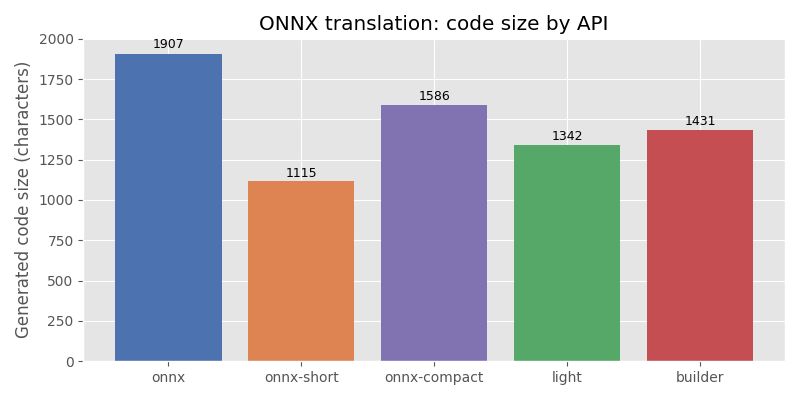
The bar chart compares the number of characters produced by each API for the
same model. "onnx-short" is always ≤ "onnx" because it compresses
large initializers. "onnx-compact" is typically shorter than "onnx"
because it uses a single nested expression instead of building separate lists.
import matplotlib.pyplot as plt  # noqa: E402

api_labels = ["onnx", "onnx-short", "onnx-compact", "light", "builder"]
code_sizes = [
    len(code_onnx),
    len(code_short),
    len(code_compact),
    len(code_light),
    len(code_builder),
]

fig, ax = plt.subplots(figsize=(8, 4))
bars = ax.bar(
    api_labels, code_sizes, color=["#4c72b0", "#dd8452", "#8172b2", "#55a868", "#c44e52"]
)
ax.set_ylabel("Generated code size (characters)")
ax.set_title("ONNX translation: code size by API")
for bar, size in zip(bars, code_sizes):
    ax.text(
        bar.get_x() + bar.get_width() / 2,
        bar.get_height() * 1.01,
        str(size),
        ha="center",
        va="bottom",
        fontsize=9,
    )
plt.tight_layout()
plt.show()
Total running time of the script: (0 minutes 0.118 seconds)
Related examples
MiniOnnxBuilder: serialize tensors to an ONNX model