
Note
Go to the end to download the full example code.
Benchmark Abs: onnxruntime vs onnx-light + onnx-light-cpu#
This example compares three ways of computing the elementwise absolute value
of a float32 array across a range of input sizes:
onnxruntime - running a single-node
AbsONNX model.onnx-light + onnx-light-cpu - the SIMD-accelerated
Abskernel thatonnx-lightdispatches to. The same ONNX model used by onnxruntime is evaluated by anonnx-lightReferenceEvaluatoron which theonnx-light-cpuAbskernel has been registered (onnx_light_cpu.register_kernels()); the kernel provides runtime AVX-512/AVX2/AVX/SSE2 dispatch.numpy -
numpy.abs(), used as a reference baseline.
The three back-ends compute the same result; the goal here is to see how their timings evolve as the array grows from a few hundred to a hundred million elements.
Setup#
Import the onnx-light-cpu registration helper and report which SIMD level
the current CPU provides. The mapping is 0=None, 1=SSE2, 2=AVX,
3=AVX2 and 4=AVX512. onnx-light is not published on PyPI, so when
it is not importable the example falls back to calling the compiled kernel
directly; this keeps the documentation build working everywhere.
import importlib.util
import time

import numpy as np
import onnx
import onnxruntime
from onnx import TensorProto, helper

from onnx_light_cpu import register_kernels
from onnx_light_cpu.onnx_py._cpukernels import (
    abs as cpu_abs,
    detect_simd_level,
    has_cpu_kernels,
)

_HAS_ONNX_LIGHT = importlib.util.find_spec("onnx_light") is not None

_SIMD_NAMES = {0: "scalar", 1: "SSE2", 2: "AVX", 3: "AVX2", 4: "AVX-512"}

assert has_cpu_kernels()
level = detect_simd_level()
simd_name = _SIMD_NAMES.get(level, level)
print(f"CPU kernels available, SIMD level: {level} ({simd_name})")
CPU kernels available, SIMD level: 4 (AVX-512)
Build the onnx-light evaluator#
onnx-light evaluates the same model with its C++ runtime. Registering the
onnx-light-cpu kernels overrides the built-in Abs so every Abs node in
the model dispatches to the SIMD-accelerated kernel. When onnx-light is
not installed the same kernel is invoked directly through the compiled
extension so the benchmark still runs.
if _HAS_ONNX_LIGHT:
    from onnx_light.onnx.reference import ReferenceEvaluator

    light_session = ReferenceEvaluator(model)
    register_kernels(light_session)

    def run_light(inp):
        return light_session.run(None, {"X": inp})[0]

    light_label = "onnx-light + onnx-light-cpu"
else:

    def run_light(inp):
        return cpu_abs(inp)

    light_label = "onnx-light-cpu"
Timing helper#
Each candidate is called repeat times and the best (minimum) wall-clock
time is kept to reduce the impact of scheduling noise. The number of repeats
shrinks as the arrays grow so the whole benchmark stays fast.
def measure(func, repeat):
    best = float("inf")
    for _ in range(repeat):
        start = time.perf_counter()
        func()
        best = min(best, time.perf_counter() - start)
    return best
Run the benchmark#
For every size the same input is fed to the three back-ends. The results are
checked against numpy.abs() to make sure every implementation agrees.
sizes = [10**k for k in range(2, 9)]
rng = np.random.default_rng(0)

rows = []
for size in sizes:
    inp = rng.uniform(-100.0, 100.0, size=size).astype(np.float32)
    expected = np.abs(inp)

    repeat = max(3, min(200, 2_000_000 // size))

    numpy_time = measure(lambda inp=inp: np.abs(inp), repeat)

    cpu_time = measure(lambda inp=inp: run_light(inp), repeat)
    assert np.array_equal(run_light(inp), expected), size

    ort_time = measure(lambda inp=inp: session.run(None, {"X": inp}), repeat)
    assert np.array_equal(session.run(None, {"X": inp})[0], expected), size

    rows.append((size, numpy_time, cpu_time, ort_time))
    print(
        f"size={size:>9} | numpy={numpy_time * 1e6:10.2f} us | "
        f"onnx-light-cpu={cpu_time * 1e6:10.2f} us | "
        f"onnxruntime={ort_time * 1e6:10.2f} us"
    )

sizes = np.array([r[0] for r in rows])
numpy_times = np.array([r[1] for r in rows])
cpu_times = np.array([r[2] for r in rows])
ort_times = np.array([r[3] for r in rows])
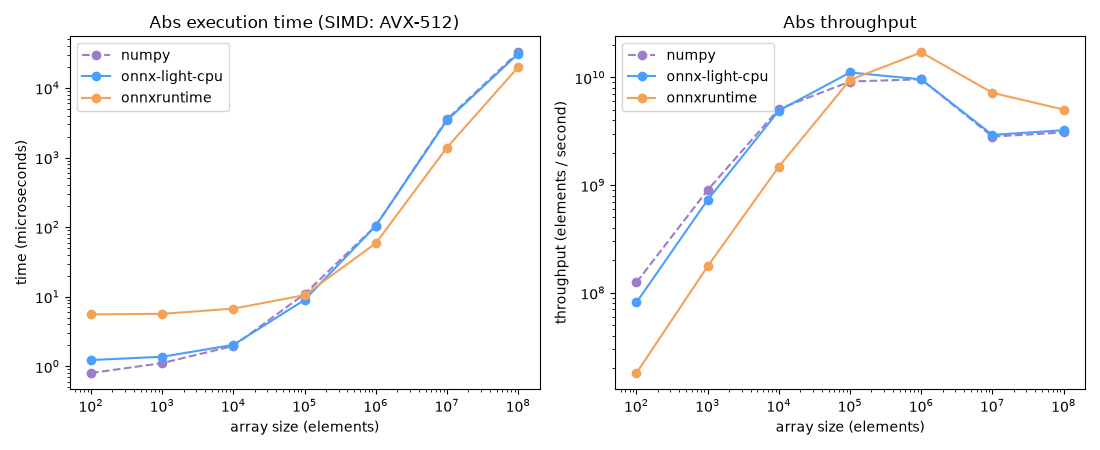
size=      100 | numpy=      0.80 us | onnx-light-cpu=      1.23 us | onnxruntime=      5.57 us
size=     1000 | numpy=      1.11 us | onnx-light-cpu=      1.37 us | onnxruntime=      5.68 us
size=    10000 | numpy=      1.96 us | onnx-light-cpu=      2.03 us | onnxruntime=      6.74 us
size=   100000 | numpy=     10.92 us | onnx-light-cpu=      8.99 us | onnxruntime=     10.54 us
size=  1000000 | numpy=    104.09 us | onnx-light-cpu=    104.28 us | onnxruntime=     58.51 us
size= 10000000 | numpy=   3543.24 us | onnx-light-cpu=   3420.85 us | onnxruntime=   1391.11 us
size=100000000 | numpy=  32434.21 us | onnx-light-cpu=  30929.90 us | onnxruntime=  19875.90 us
Plot the timings#
The left panel shows the raw execution time versus the array size on a log-log scale. The right panel shows the throughput (elements processed per second), which highlights the fixed per-call overhead at small sizes.
import matplotlib.pyplot as plt

fig, (ax_time, ax_tput) = plt.subplots(1, 2, figsize=(11, 4.5))

ax_time.plot(sizes, numpy_times * 1e6, "o--", label="numpy", color="#9b7ec8")
ax_time.plot(
    sizes,
    cpu_times * 1e6,
    "o-",
    label=light_label,
    color="#4a9eff",
)
ax_time.plot(sizes, ort_times * 1e6, "o-", label="onnxruntime", color="#f4a259")
ax_time.set_xscale("log")
ax_time.set_yscale("log")
ax_time.set_xlabel("array size (elements)")
ax_time.set_ylabel("time (microseconds)")
ax_time.set_title(f"Abs execution time (SIMD: {simd_name})")
ax_time.legend()

ax_tput.plot(sizes, sizes / numpy_times, "o--", label="numpy", color="#9b7ec8")
ax_tput.plot(
    sizes,
    sizes / cpu_times,
    "o-",
    label=light_label,
    color="#4a9eff",
)
ax_tput.plot(sizes, sizes / ort_times, "o-", label="onnxruntime", color="#f4a259")
ax_tput.set_xscale("log")
ax_tput.set_yscale("log")
ax_tput.set_xlabel("array size (elements)")
ax_tput.set_ylabel("throughput (elements / second)")
ax_tput.set_title("Abs throughput")
ax_tput.legend()

fig.tight_layout()
plt.show()
Total running time of the script: (0 minutes 1.482 seconds)